

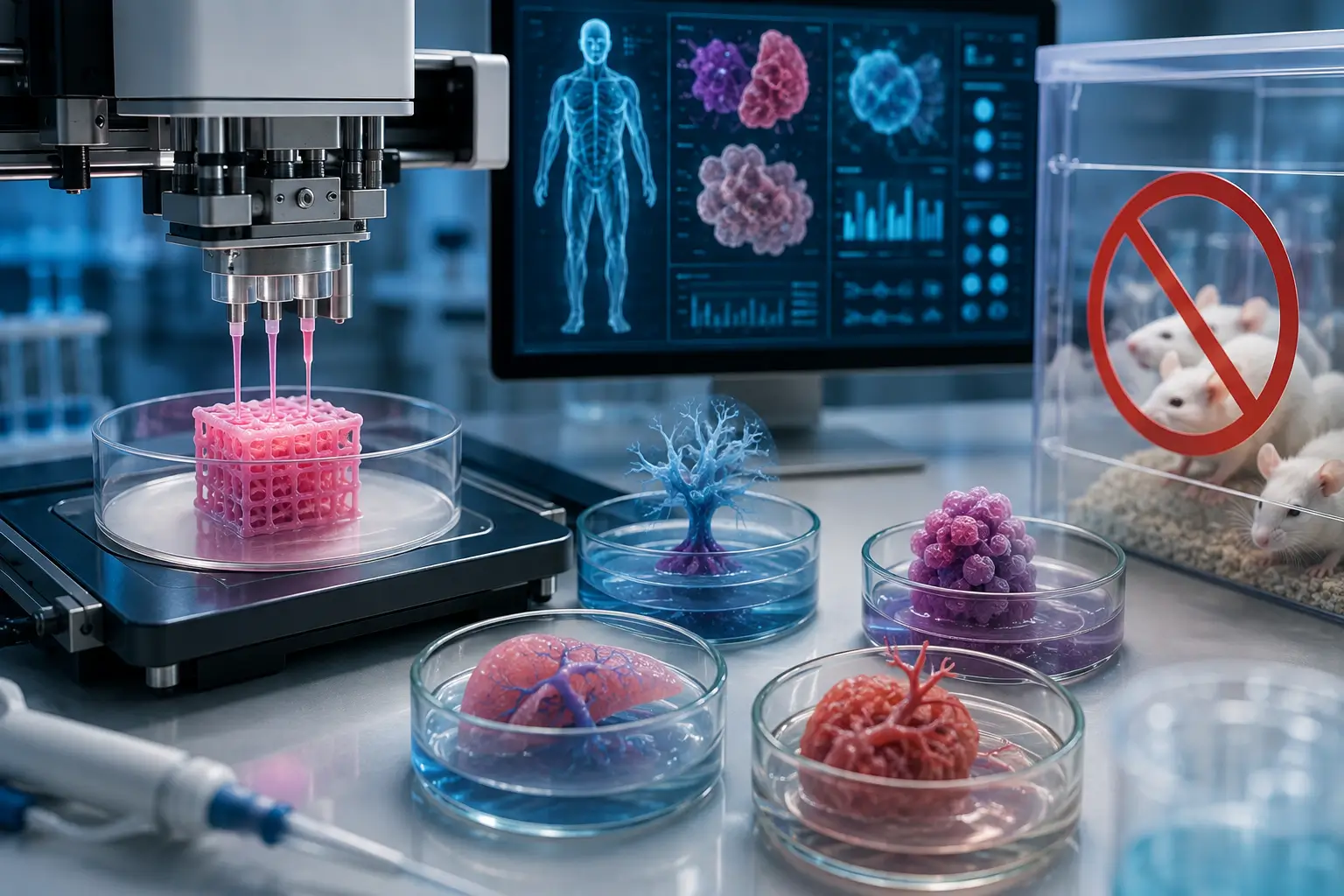
For decades, scientists have used animals to study diseases, test medicines, and understand how treatments may affect the human body. Animal research has played an important role in medical science, but it also has limitations. A medicine that works safely in an animal does not always behave in exactly the same way in humans.
Researchers are finding new ways to study the human body without relying just on animals. Two popular methods are 3D bioprinting and miniature lab-grown organs (organoids). The basic idea is quite interesting. Instead of testing every new medicine on an animal first, scientists can create tiny human-like tissues in a laboratory and study how those tissues respond to a drug.
These tiny models cannot reproduce everything that happens inside a complete human body. However, they can provide useful information about specific organs, diseases, drug responses, and possible toxicity. The FDA has also been encouraging the use of human-relevant alternatives, including organoids, three-dimensional models, and other “new approach methodologies” in drug development.
So, are these tiny tissues really going to replace animal testing? The honest answer is not completely yet. But they could reduce animal use in several areas and make some parts of medical research more human-focused.
What Are Organoids?
An organoid is a small, three-dimensional group of cells that can copy some features of a real human organ. Scientists usually create organoids from stem cells or other suitable cells and provide the right conditions for them to grow and organise themselves.
You can think of an organoid as a miniature laboratory version of part of an organ.
For example, researchers can create intestinal, brain, liver, kidney and other types of organoids for research. These models do not become complete human organs, but they can reproduce certain structures and functions of the tissues they represent.
This gives scientists something much closer to human tissue than a simple layer of cells growing on a flat laboratory dish.
Why Are 3D Models Better Than Traditional Cell Cultures?
Traditional laboratory cell cultures often grow on flat surfaces. This is useful, but the human body does not work like a flat plastic dish. Cells in our body exist in three-dimensional environments. They interact with neighbouring cells, surrounding materials, and chemical signals.
A 3D model can recreate some of these conditions. That extra structure can help researchers understand how cells behave in a more realistic environment. Research reviews have highlighted the ability of organoids and other 3D models to reproduce aspects of human tissue biology more closely than conventional 2D cultures.
What Is 3D Bioprinting?
3D bioprinting takes the idea of 3D printing and applies it to living cells and biological materials. Instead of printing plastic or metal, a bioprinter can place cells and special materials in carefully controlled patterns.
Scientists use materials called bioinks to help position and support cells. Depending on the purpose, these materials can contain cells, biomaterials, and other components that help create a suitable environment for tissue growth.
The printer can build structures layer by layer or use other printing methods to arrange cells in specific locations. This gives researchers something very useful for control over where different cells go inside a 3D structure.
Recent research describes bioprinting as a promising method for creating more complex human-relevant laboratory models for drug screening and disease research.
How Do Organoids and 3D Bioprinting Work Together?
Organoids already have the ability to organise themselves into small tissue-like structures. 3D bioprinting adds another level of control. Scientists can use organoids, individual cells, or groups of cells as biological building blocks and place them in particular positions.
This approach is called organoid bioprinting. For example, researchers may want to create a tissue model containing several types of cells. Instead of allowing the cells to organise completely on their own, bioprinting can help position them more precisely.
How Can These Technologies Reduce Animal Testing?
The biggest opportunity comes from drug testing and disease research. Imagine researchers have developed a potential medicine for a liver disease.
Traditionally, researchers may study the drug through several stages, including laboratory cell studies and animal experiments before human trials. With better human tissue models, scientists can study some questions using human-derived tissues before moving forward.
A laboratory-grown liver model could help researchers ask:
- Does the drug affect liver cells?
- Does it appear toxic at certain doses?
- How do liver cells respond to the medicine?
- Does the disease change how the cells behave?
These models cannot answer every question, but they can provide additional human-relevant information. The FDA’s recent work on reducing animal testing specifically includes organoids, 3D models, and organs-on-chips among the alternative methods being considered for drug development.
Drug Testing Is One of the Biggest Uses
One important application of 3D bioprinting for drug testing involves creating tissue models that researchers can expose to potential medicines.
Researchers can observe how the tissue responds. This can help them identify promising drug candidates and detect potential problems earlier in the research process. Bioprinted models have been explored for tissues including skin, liver, heart, kidney, bone, and cancer models. Reviews have highlighted their potential use in pharmaceutical research and preclinical drug screening.
For pharmaceutical companies, finding problems early can matter a lot. A candidate that shows poor results in an early human-relevant model may not deserve the same amount of time and money for later testing.
Organoids Can Help Study Human Diseases
These models can also help scientists understand diseases. For example, researchers can create organoids from cells carrying certain disease-related characteristics and compare them with healthy models.
This can help scientists observe what changes inside the tissue. Brain organoids have attracted interest in neuroscience research, while intestinal organoids can help researchers study aspects of digestive diseases. Liver organoids can support research into liver function and drug toxicity.
The important point is that scientists can study human cells in a controlled environment. That can provide information that researchers cannot always obtain from an animal model.
Personalised Medicine Could Benefit Too
One particularly interesting possibility involves personalised medicine. Different people can respond differently to the same medicine. Researchers are exploring whether patient-derived cells can help create models that reflect aspects of an individual patient’s biology.
In the future, a doctor might potentially have access to laboratory models created from a patient’s cells and use them to study how certain treatments affect those cells. This area still needs considerable research and validation. It is not a routine replacement for clinical decision-making today. However, the idea shows why organoids are attracting attention beyond basic laboratory research.
3D Bioprinting vs Organoids
Although people often discuss them together, these technologies are not exactly the same.
| Feature | Organoids | 3D Bioprinting |
| Basic idea | Cells organise into small tissue-like structures | Printer places cells and biomaterials in controlled patterns |
| Main strength | Can reproduce some organ-like features | Provides greater control over tissue structure |
| Common use | Disease research and drug studies | Tissue models, drug testing and biofabrication |
| Main challenge | Variation and incomplete organ function | Materials, cell survival and complex tissue construction |
| Animal testing role | Can provide human-relevant laboratory data | Can create more structured human tissue models |
Researchers are increasingly combining both approaches rather than treating them as competing technologies.
What Are the Benefits?
1. More Human-Relevant Information
One major benefit is the use of human cells and tissues. Animal biology differs from human biology in many ways. Human-derived models may therefore provide information that is more directly relevant to people for certain research questions.
2. Better Control
3D printing allows scientists to control where cells and biological materials go. That can help researchers create more consistent experimental models.
3. Less Dependence on Animals
If researchers can answer some questions using organoids or bioprinted tissues, they may not need to use animals for every stage of a study. This supports the broader goal of reducing animal use in research.
4. Potentially Faster Drug Screening
Researchers can test potential compounds using laboratory models before investing heavily in later-stage studies. However, scientists still need to validate these models carefully before relying on them for major decisions.
What Are the Limitations?
It is important not to believe every exciting headline about this technology. Organoids are not miniature humans. They usually represent only some features of an organ. A real human organ has blood vessels, immune cells, nerves, hormones, and interactions with many other organs.
Many organoids cannot reproduce all these systems. Researchers also face problems involving consistency, maturity, scaling and long-term growth. Recent reviews continue to identify challenges such as vascularisation, anatomical complexity, standardisation and regulatory validation.
3D bioprinting also has technical challenges. Keeping cells alive while printing them, selecting suitable bioinks, and creating complex tissue structures remain important research problems. So, saying that organoids have already completely replaced animal testing would be misleading.
Will Animal Testing Disappear Completely?
Probably not in the immediate future. Different research questions require different models.
A tiny organoid can help researchers understand how a particular tissue reacts to a medicine. But it cannot easily reproduce the interaction between the brain, liver, kidneys, immune system, and other organs throughout an entire living body.
Scientists therefore see organoids, bioprinted tissues, organ-on-chip systems and computer models as part of a broader group of new approach methodologies, rather than as one universal replacement.
Nature reported in 2026 that these methods are progressing, but researchers still see significant challenges before they can replace animal procedures completely.
What Does This Mean for India?
For India, these technologies could become increasingly relevant as research institutions, biotechnology companies and pharmaceutical developers look for better ways to study medicines and diseases.
India has a large pharmaceutical and biotechnology sector, which creates opportunities for human-relevant testing models. But the same basic rule applies here as anywhere else: a new technology needs proper validation before researchers can depend on it for important medical decisions.
For Indian patients, the long-term hope is simple. Better laboratory models could help researchers develop medicines that work more reliably in humans and identify safety concerns earlier.
The Future of Micro-Tissues
The future may not involve choosing between animals, organoids, or bioprinted tissues. Instead, researchers may combine several methods.
An experiment could use a patient’s cells, an organoid, a 3D-bioprinted tissue model, an organ-on-chip system and computer-based analysis. Each method could answer a different question.
This combined approach may provide a much more detailed picture of how a medicine behaves before researchers move into human clinical trials. Recent research into 3D biofabricated models shows that scientists are already working toward more complex systems containing different cell types, tissue interactions, and improved structures.
Conclusion
3D bioprinting and organoids are changing the way scientists think about drug testing and animal alternatives. Organoids provide small, three-dimensional models that can reproduce some features of human organs. 3D bioprinting adds greater control by allowing researchers to arrange cells and biological materials into carefully designed structures. Together, these technologies can help researchers study diseases, test medicines and investigate toxicity using human-relevant laboratory models.
But they are not yet a complete replacement for animal testing. Scientists still need to solve important problems involving complexity, blood supply, consistency, standardisation and regulatory acceptance. The most realistic future is therefore not a sudden end to animal research. Instead, researchers are moving toward a system where organoids, 3D bioprinted tissues, organs-on-chips, computer models and other methods reduce the need for animals wherever they can provide reliable answers. For medical research, that could mean better human-focused science, more efficient drug development and, over time, fewer animals used in experiments.