

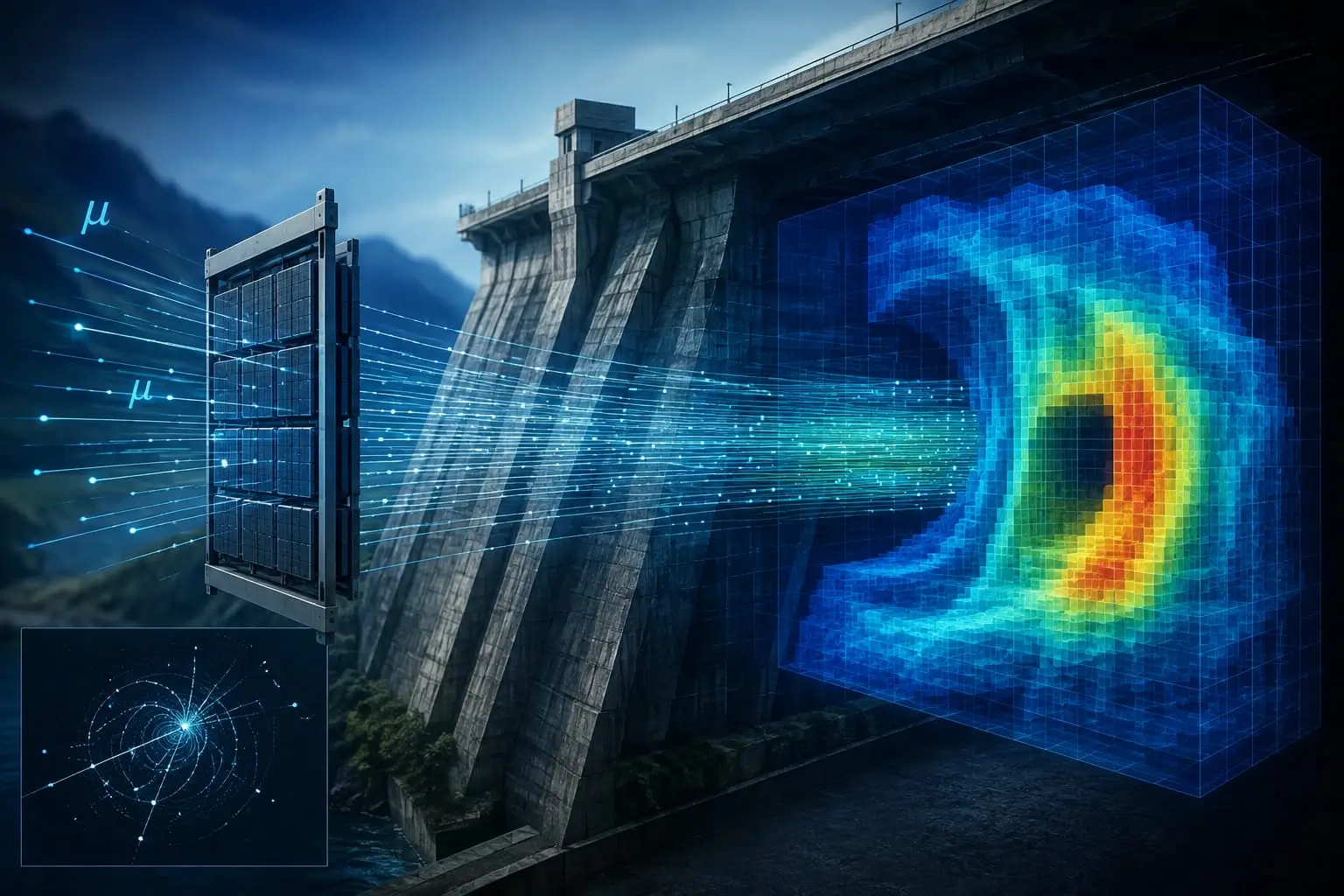
Imagine you want to look inside a huge mountain, an ancient pyramid, a volcano, or a thick concrete structure. You cannot simply cut it open to see what is inside. Traditional X-rays also have serious limits when the object becomes extremely large or dense.
This is where muon tomography offers an interesting solution. Muon tomography uses naturally occurring particles called muons to study the inside of large and solid objects. In simple terms, scientists can use muons somewhat like an X-ray beam to understand what lies beneath a surface without physically breaking the structure.
The idea sounds like something from a science-fiction movie, but the basic principle comes from well-known particle physics. Muons constantly reach Earth from space. They can travel through much more material than ordinary light and can pass through thick layers of rock and other substances. Scientists place detectors in suitable locations and study how many muons pass through an object and how their movement changes.
What Is Muon Tomography?
Muon tomography is an imaging technique that uses muons to examine the internal structure of large or dense objects. It works on a principle similar to medical X-ray imaging. In an X-ray scan, X-rays pass through the body, and a detector records how much radiation reaches the other side.
Muon tomography follows a similar basic idea, but it uses muons instead of X-rays. The major difference comes from the penetrating power of muons. Muons can travel through large amounts of matter before they lose enough energy to stop. This makes them useful for studying objects that are too thick for conventional imaging methods.
Researchers can measure the number and direction of muons that pass through a target. Differences in the measurements can reveal differences in the material inside.
What Exactly Is a Muon?
Before understanding muon tomography, it helps to know what a muon is. A muon is a subatomic particle. It belongs to the same broad family as the electron, but it has a much greater mass.
Muons carry an electric charge and behave in many ways like heavier versions of electrons. You do not need a particle accelerator to find them. Muons naturally form high in Earth’s atmosphere when cosmic rays from space collide with atoms in the atmosphere. These collisions create showers of secondary particles, including muons.
Many of these muons travel down towards Earth’s surface. That means a continuous supply of muons reaches us naturally.
How Are Muons Created?
The story starts with cosmic rays. Cosmic rays are high-energy particles that travel through space. When some of them enter Earth’s atmosphere, they collide with particles in the air.
These collisions produce other particles. Some of those particles eventually decay and produce muons. Muons then travel through the atmosphere and reach the ground.
They move extremely quickly and can pass through materials that would stop many other particles. This natural supply makes muons particularly interesting for scientists who want to study large structures.
How Does Muon Tomography Work?
The basic process involves three important parts:
- A source of muons
- The object being studied
- A muon detector
In many applications, researchers use naturally occurring cosmic-ray muons. The detector records information about the muons that pass through or around the target.
Step 1: Muons Reach the Target
Muons arrive from different directions. Some travel through air, while others pass through rock, concrete, soil, or another material before reaching a detector. The amount of material a muon encounters affects whether it reaches the detector and how its path changes.
Step 2: The Detector Records the Muons
A muon detector can record the arrival of these particles. Depending on the type of experiment, researchers can measure information such as the muon’s direction and whether it passed through the target.
The detector collects many measurements over time. One muon does not provide enough information to create a useful picture. Researchers need many particle observations.
Step 3: Scientists Analyse the Data
Scientists then compare the number and paths of detected muons with what they would expect if the object had a particular density. Areas containing denser material generally affect the muon signal differently from areas containing less dense material. Computer-based reconstruction methods can then turn these measurements into a density map.
This process allows researchers to identify unusual areas inside the target.
Why Can Muons Pass Through Solid Objects?
This is one of the most interesting parts of the technology. Matter may look completely solid to us, but at the atomic level, it contains enormous amounts of space between particles. Muons interact with matter as they travel through it. However, because of their properties and high energy, many muons can travel through significant amounts of material before stopping.
An everyday example can help. Imagine throwing a large number of small balls through a thick forest. Some balls may pass through easily, while others may hit trees and change direction or lose energy.
A muon passing through matter behaves in a more complicated physical way, but the basic idea is similar: the material affects how the particles travel. Scientists study those changes to learn about the material inside.
Muon Tomography vs Traditional X-Rays
Muon tomography and X-ray imaging share a basic concept, but their practical uses differ.
| Feature | X-Ray Imaging | Muon Tomography |
| Main particle | X-rays | Muons |
| Typical source | X-ray equipment | Often cosmic rays |
| Penetration | Limited by material and energy | Very high for many applications |
| Large structures | Can be difficult | Particularly useful |
| Energy requirement | Requires X-ray source | Natural muons can provide the source |
| Common use | Medical and industrial imaging | Large structures, geology and research |
This does not mean muon tomography will replace X-rays. X-rays remain extremely useful when scientists need detailed images of smaller objects. Muon tomography becomes attractive when the target is extremely large, thick, or difficult to access.
Applications of Muon Tomography
Researchers have explored muon imaging for several fascinating applications.
1. Studying Volcanoes
Volcanoes contain complicated internal structures. Scientists need to understand features such as variations in rock density, cavities, and pathways inside volcanic formations.
Placing muon detectors around or below parts of a volcano can allow researchers to study how muons travel through the mountain. This approach is called muography in many scientific contexts. It can provide information about the internal density of a volcano without drilling into it.
2. Exploring Ancient Structures
Archaeology is another fascinating area. Researchers can use muons to look inside large ancient structures without damaging them. The technique became widely known to the public after researchers used muon imaging to investigate the internal structure of the Great Pyramid of Giza.
Muon measurements helped researchers identify previously unknown areas inside the pyramid. This demonstrates one of the biggest advantages of the method: scientists can investigate historical structures without cutting through walls.
3. Mining and Geology
Mining companies and geologists need to understand what lies underground. Traditional drilling can provide valuable information, but drilling can also cost significant time and money. Muon imaging can potentially provide information about large underground structures by measuring how many muons travel through different sections.
Researchers can use these density variations to understand geological formations.
4. Monitoring Large Infrastructure
Muon-based methods can also support research into large structures and industrial objects. The technique can potentially help researchers detect differences in density or identify internal features that are difficult to observe from outside.
However, the usefulness of muon tomography depends heavily on the size, density, and location of the target.
What Is Muography?
You may come across another word when researching muon tomography: muography. Muography refers broadly to imaging or studying the internal structure of objects using naturally occurring muons.
The terms can overlap, and scientists may use them differently depending on the application. In simple terms, you can think of muography as a way of using muons to create information about the inside of a large object.
Advantages of Muon Tomography
Muon tomography has several important advantages.
1. It Can Study Very Large Objects
A medical X-ray machine works well for a human body because the body has a manageable size. A mountain is a completely different problem. Muons provide a way to study extremely large structures because they can travel through substantial amounts of material.
2. It Can Work Without Damaging the Target
Researchers do not necessarily need to drill, cut, or break apart the object. This makes the method attractive for archaeology, geology, and other situations where preserving the target matters.
3. It Can Use Natural Radiation
Many muon tomography experiments rely on cosmic-ray muons that naturally reach Earth. Researchers therefore do not always need to build a powerful particle source to produce the muons.
What Are the Limitations?
Muon tomography is impressive, but it is not a magic scanning machine.
1. It Can Take Time
Researchers need to collect enough muon data to produce useful measurements. The larger or more detailed the study, the more data they may need.
2. Resolution Can Be Limited
Muon tomography does not create razor-sharp images like a medical scan. Instead, its main strength is scanning massive structures and spotting major differences in density.
3. Equipment and Analysis Matter
Scientists need suitable detectors and reliable data-processing methods. The detector also needs to sit in a suitable position relative to the target.
4. It Does Not Work Equally Well Everywhere
The target’s size, density, shape, and location all influence the quality of the results. Researchers must design the experiment according to the specific problem they want to solve.
Why Is Muon Tomography Important?
The biggest value of muon tomography comes from what it allows scientists to investigate without physically entering or damaging a structure. A mountain cannot simply be opened to inspect its interior. An ancient monument should not be damaged just to find a hidden chamber. A volcano cannot be cut open so researchers can study its internal structure.
Muon tomography offers another option. It turns naturally occurring particles from cosmic-ray interactions into a source of information about the hidden world around us. That makes it a fascinating example of how basic particle physics can solve practical problems.
Conclusion
Muon tomography may sound like a complicated particle physics concept, but its basic idea is surprisingly easy to understand. Cosmic rays interact with Earth’s atmosphere and produce muons. These particles constantly travel towards the ground. Because many high-energy muons can pass through large amounts of material, scientists can use detectors to measure how those particles behave after travelling through a solid structure.
From ancient pyramids and volcanoes to geological formations and large industrial structures, this technique gives scientists a way to look inside objects without cutting them open. That combination of particle physics, detectors, and clever data analysis turns invisible cosmic particles into a powerful way of exploring the hidden interiors of our world.