

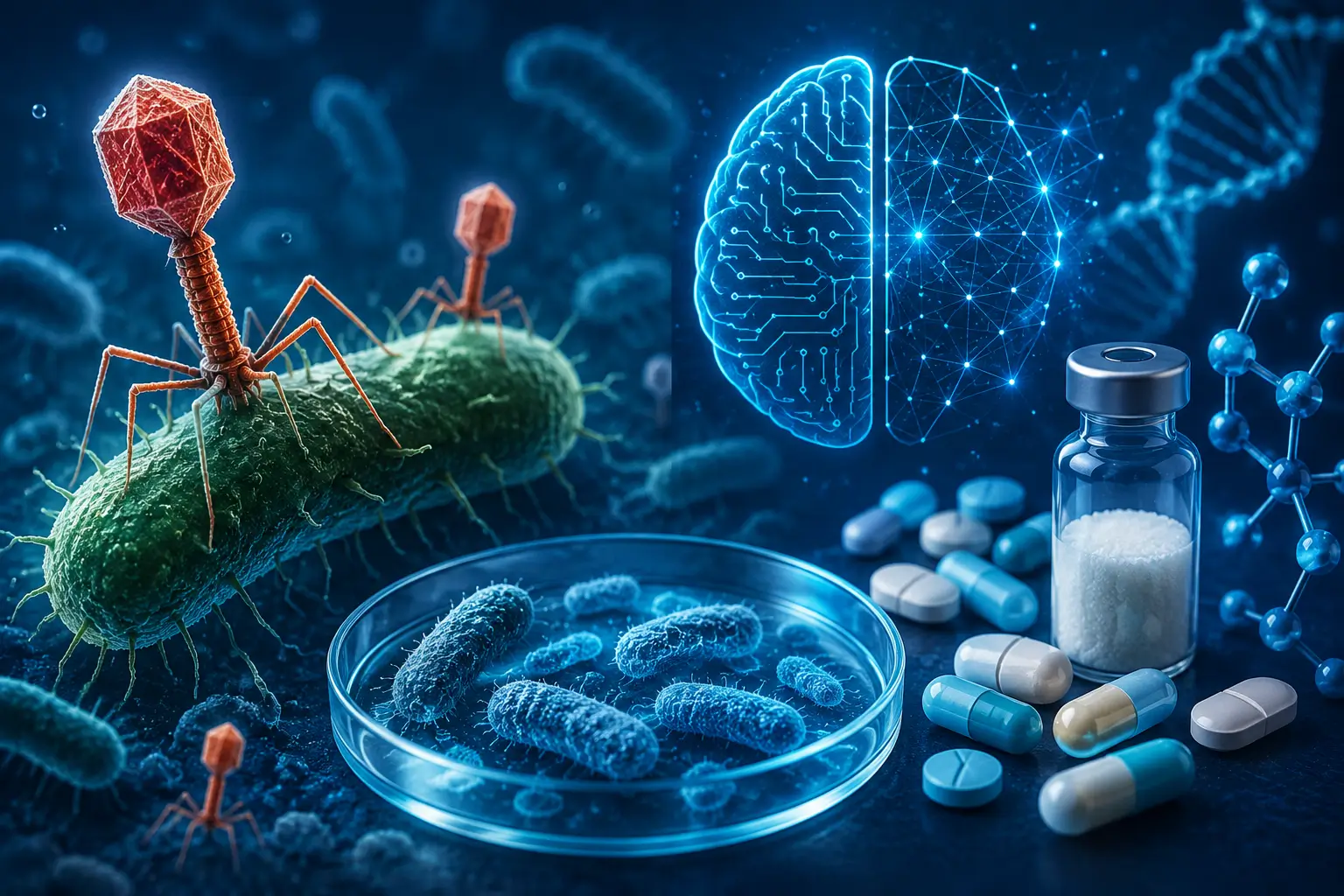
For many years, antibiotics have helped doctors treat infections that were once dangerous or even deadly. But bacteria are becoming better at surviving these medicines. When bacteria stop responding to commonly used antibiotics, doctors may have fewer treatment options. These difficult-to-treat bacteria are often called superbugs.
This problem has become a serious health concern around the world, including India. Antimicrobial resistance can make infections harder to treat, increase hospital stays, and raise the risk of serious illness.
Researchers are now looking beyond traditional antibiotics. Two interesting areas are bacteriophage therapy and AI-designed antibiotics. The ideas sound complicated, but the basic concept is simple. Bacteriophages use naturally occurring viruses to target bacteria, while AI can help researchers search for and design new antibiotic molecules much faster.
These approaches are promising, but they are not magic solutions. Scientists still need strong clinical evidence, safety testing, and proper medical approval before many of these treatments can become widely available.
What Are Superbugs?
A superbug is a microorganism that has developed resistance to medicines that doctors normally use to treat infections. In the case of bacterial infections, this means some antibiotics may no longer work against the bacteria.
Suppose a person has a bacterial infection and the doctor gives an antibiotic. Normally, the medicine attacks the bacteria and helps control the infection. But if the bacteria have developed resistance, the same medicine may not work properly. The doctor may then need to choose another antibiotic. If the bacteria resist several medicines, treatment becomes much more difficult.
Why Does Antibiotic Resistance Happen?
Bacteria naturally change over time. However, the inappropriate or excessive use of antimicrobial medicines can speed up the development and spread of resistance. WHO also highlights misuse and overuse of antimicrobials as important drivers of antimicrobial resistance.
This is why people should not take antibiotics simply because they have a cold, cough, or fever. Many common infections do not need antibiotics, and unnecessary antibiotic use can contribute to resistance.
Doctors also need to choose antibiotics carefully and use them only when they are appropriate.
What Is Bacteriophage Therapy?
Bacteriophage therapy, often called phage therapy, uses bacteriophages to target bacteria.
Bacteriophages are viruses that naturally infect bacteria. Certain types can attach themselves to specific bacteria, enter them, and eventually destroy the bacterial cell. Importantly, therapeutic phages are selected to target bacteria rather than human cells.
You can think of a bacteriophage as a very specific hunter. In place of attacking many types of organisms, it looks for a particular bacterial target. This specificity is one of the reasons researchers are interested in phage therapy.
How Does Phage Therapy Work?
The process can be explained in a simple way.
First, doctors need to understand which bacteria are causing the infection. Laboratory testing can help identify the bacteria.
Researchers can then look for a suitable phage that can attack that particular bacterial strain. In some situations, doctors and researchers may use a combination of several phages because one phage may not work against every strain.
Once a suitable treatment is identified, the phages can be used under medical supervision. WHO says phages can potentially be used alone or alongside antibiotics, particularly when infections involve antibiotic-resistant bacteria.
Why Are Scientists Interested in Phage Therapy?
One major advantage is specific targeting. Traditional antibiotics can affect a broad range of bacteria. Phages can be much more specific. This could potentially help researchers target harmful bacteria while causing less disruption to beneficial bacteria in the body.
Phages also offer an option when some antibiotics stop working. Researchers have reported cases involving difficult infections where phage therapy showed promise. WHO has highlighted examples involving antibiotic-resistant bacteria such as Pseudomonas aeruginosa, Staphylococcus aureus, and other pathogens.
What Are the Limitations of Phage Therapy?
Phages have an important limitation: they are highly specific. A phage that attacks one bacterial strain may not attack another strain of the same species. Doctors therefore need to identify the bacteria and find an appropriate phage.
Bacteria can also develop resistance to phages. Researchers are studying ways to manage this problem, including using combinations of phages. Another challenge involves regulation and clinical evidence.
WHO notes that phages are not approved medicines in most countries and that more clinical evidence is needed before they can become widely available for routine human treatment. So, people should not try to obtain or use phage products on their own.
What Are AI-Designed Antibiotics?
The second promising area involves artificial intelligence and antibiotic discovery. Researchers have enormous numbers of possible chemical compounds to investigate. Testing every possibility in the laboratory would take a huge amount of time and money.
AI and machine learning can help researchers search through large numbers of chemical structures and predict which ones may have antibacterial activity. In simple words, researchers can use computers as a screening assistant.
The computer does not replace laboratory testing. Instead, it helps researchers identify promising candidates that deserve further investigation.
How Can AI Help Create New Antibiotics?
Traditional drug discovery can take many years because scientists need to identify a promising compound, test it, improve it, and study its safety.
AI can help narrow down the search.
For example, researchers have used machine learning to identify potential antibiotics against difficult bacteria. One study reported the discovery of abaucin, a candidate that showed activity against Acinetobacter baumannii.
More recently, researchers have explored generative AI approaches that can design previously unknown antibiotic compounds. The important point is that AI can help researchers search chemical possibilities in ways that were previously difficult to manage.
AI and Phage Therapy Could Work Together
These two technologies do not necessarily have to compete. Researchers could potentially use advanced computer methods to improve how they identify, study, and match bacteriophages with bacterial infections. AI may also help scientists analyse bacterial genomes and understand resistance patterns.
At the same time, AI can support the search for new antibiotics.
This creates a broader strategy against antibiotic resistance:
- Develop new antibiotics.
- Find alternatives such as phages.
- Improve bacterial testing.
- Track resistance more effectively.
- Use existing antibiotics responsibly.
The fight against superbugs will probably require several approaches rather than one miracle treatment.
Bacteriophage Therapy vs AI-Designed Antibiotics
| Feature | Bacteriophage Therapy | AI-Designed Antibiotics |
| Basic idea | Uses viruses that target bacteria | Uses computer-assisted drug discovery |
| Main target | Specific bacterial infections | Potentially different bacterial infections |
| Main advantage | Highly targeted approach | Can speed up candidate discovery |
| Current status | Still requires more evidence for wider routine use | Many candidates remain in research and testing |
| Main challenge | Finding the right phage | Proving safety and effectiveness |
| Role of doctors | Identify infection and select appropriate treatment | Test and prescribe approved medicines |
This table shows why neither approach should be viewed as a complete replacement for today’s antibiotics.
What Does This Mean for India?
Antimicrobial resistance matters greatly for India because resistant infections can place additional pressure on hospitals, patients and healthcare systems.
WHO India identifies antimicrobial resistance as a major concern and supports work involving surveillance, infection prevention, responsible antimicrobial use, and research.
India also needs better awareness among the public.
For example, taking leftover antibiotics from an earlier illness may seem harmless, but it is not a good practice. The correct medicine depends on the infection, the bacteria involved, and the patient’s condition.
Doctors may also need laboratory testing when they suspect a resistant infection. New technologies can support this effort, but responsible antibiotic use remains extremely important.
Can Phage Therapy Replace Antibiotics?
Not at present.
WHO describes phages as a promising alternative or additional approach, but also says more clinical evidence is required before phage therapy can become widely available for routine human treatment.
In some difficult cases, researchers may consider phages when conventional treatment options have failed. But this happens under specialist medical supervision.
The same applies to AI-designed antibiotics.
A molecule that looks promising in a computer model still needs laboratory testing, animal studies where appropriate, clinical trials, safety evaluation and regulatory approval.
What Could the Future Look Like?
The future of infection treatment may become more personalised. Instead of using the same approach for every bacterial infection, doctors could increasingly rely on laboratory testing to identify the exact bacteria and its resistance pattern.
For some infections, an existing antibiotic may work perfectly well. For another infection, doctors may need a newer antibiotic. In selected difficult cases, phage-based approaches may eventually become useful. AI could support all of this by helping researchers discover medicines, analyse bacterial information and identify promising treatment options.
Researchers are already exploring these possibilities. In 2026, scientific reviews have continued to examine how AI, genomic surveillance and predictive methods could contribute to the fight against antimicrobial resistance.
Conclusion
Fighting superbugs will require more than developing stronger versions of existing antibiotics. Bacteriophage therapy offers an interesting approach because certain phages can specifically target bacteria. AI-designed antibiotics offer another promising direction by helping scientists search through huge numbers of possible compounds and identify candidates for further testing.
For researchers, the message is more ambitious. The next generation of infection treatment may combine better diagnostics, responsible antibiotic use, new medicines, bacteriophages, and advanced computer-assisted drug discovery. That combination could give doctors more options when today’s antibiotics are no longer enough.