

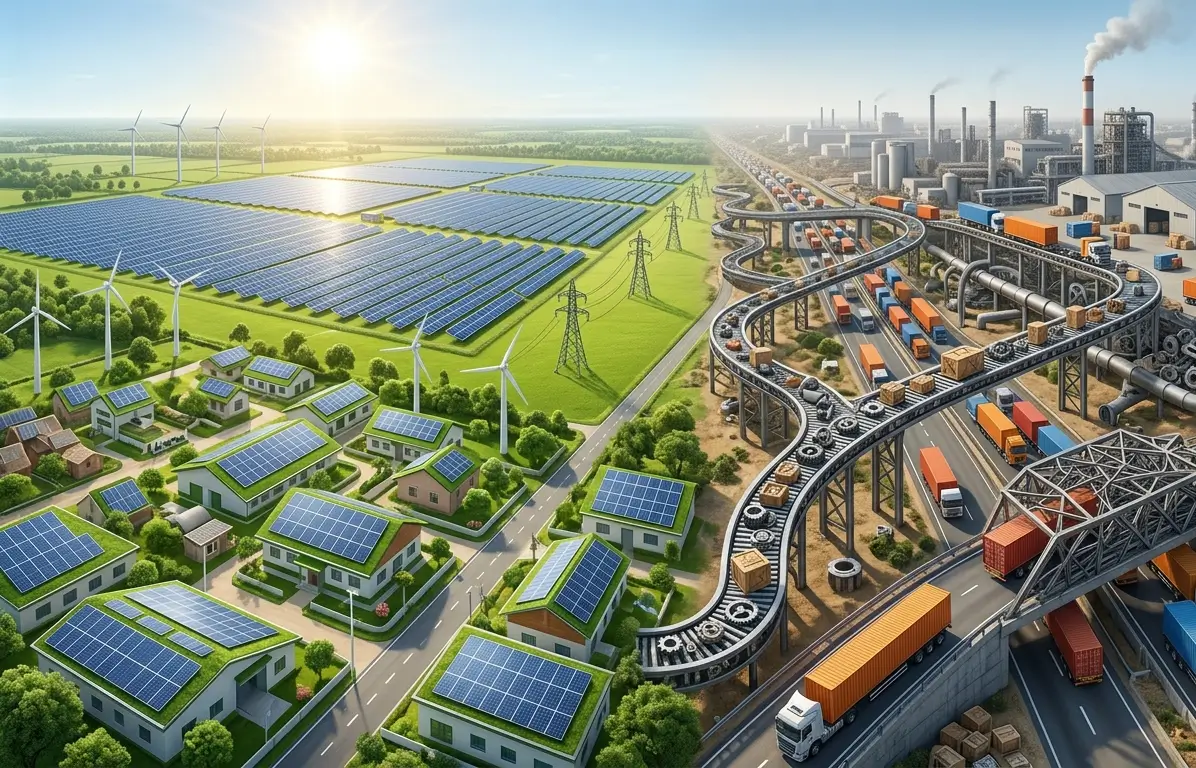
India is using more clean energy every day. The country is putting money into solar power to meet its growing electricity needs, building everything from rooftop panels on homes to huge solar farms in states like Rajasthan and Gujarat. The goal is simple: use less fossil fuel like coal and oil, and use more renewable energy. However, building a strong solar energy sector takes more than installing panels. India must also secure raw materials, improve domestic manufacturing, strengthen electricity networks, and make solar power affordable for more people. These challenges have become important parts of the discussion.
What Are India’s Solar Energy Goals for 2026?
India has set big clean energy goals to cut pollution and make its power supply more reliable. The country aims to get 500 GW of its electricity from non fossil fuel sources by 2030. This target covers sources such as solar, wind, hydropower, and nuclear energy.
India does not have a separate solar target just for 2026. The country is focusing on its bigger, long-term goals. The main focus is on building more solar projects, growing local solar factory production, and adding solar panels to more homes.
Why does India need more solar power?
India’s electricity demand continues to grow as cities expand, industries develop, and more households use air conditioners, appliances, and electronic devices. Solar power can help meet some of this demand without burning coal or natural gas during electricity generation. Solar energy also offers several benefits.
- Lower dependence on imported energy: India imports a large share of its crude oil and also relies on imports for some energy-related products. Greater renewable energy use can improve energy security over time.
- Cleaner electricity: Solar power produces electricity without direct carbon emissions during operation. It can help India reduce pollution linked to fossil fuel use.
- New employment opportunities: Solar projects need workers for manufacturing, installation, maintenance, engineering, and sales.
- Better access to electricity: Rooftop systems and suitable decentralised solar projects can help homes, businesses and institutions manage their electricity needs.
However, these benefits depend on reliable equipment, proper planning and a strong electricity network.
India’s Solar Growth: Progress Beyond Solar Panels
India has grown its solar power a lot over the past ten years. Massive solar farms, home rooftop panels, and business systems are all helping solar energy make up a bigger share of the country’s electricity. The government has also introduced programmes to support domestic manufacturing and encourage households to install rooftop solar systems.
1. The role of rooftop solar
Rooftop solar allows households, shops, schools and offices to generate electricity using panels installed on their buildings. India has grown its solar power a lot over the past ten years. Massive solar farms, home rooftop panels, and business systems are all helping solar energy make up a bigger share of the country’s electricity.
Rooftop solar can lower your electricity bills, but how much you save depends on your situation. Key factors include the upfront installation cost, how much sunlight your roof gets, your local electricity rates, and your system’s efficiency. Savings also depend on your area’s rules for sending extra power back to the grid.
2. Large solar parks and industrial projects
Large solar parks can produce electricity on a much bigger scale than individual rooftop systems. Developers often choose areas with strong sunlight and enough land to support large installations.
States such as Rajasthan and Gujarat have attracted major solar investments because of their solar resources and project opportunities. Still, developers must manage land access, transmission connections, equipment supply, and project financing before they can start generating electricity. These requirements explain why announced projects and installed solar capacity do not always grow at the same pace.
Major Bottlenecks Affecting India’s Solar Ambitions
India’s solar industry faces several challenges that could slow project development and raise costs.
1. Dependence on imported solar components
Solar panels need several key parts to work, including solar cells, silicon wafers, and polysilicon. While India now builds plenty of finished solar panels (modules), it still relies heavily on imports for these raw materials and parts. China produces most of the world’s upstream solar components. Depending on imported materials creates real risks for Indian companies.
If global prices go up, shipping gets delayed, or import rules change, Indian manufacturers face higher costs. This makes it much harder for them to finish projects on time or keep power prices low.
Why local manufacturing matters
Domestic production can help India reduce supply risks and build a stronger industrial base. However, local factories need reliable access to raw materials, skilled workers, modern equipment, and affordable financing. Simply opening more panel assembly plants will not solve every supply chain problem. India also needs to strengthen the production of cells and other important inputs.
2. High manufacturing costs
Indian solar manufacturers compete with established global suppliers that operate at a large scale. These suppliers may benefit from developed supply networks, advanced production systems, and lower costs for some components. Indian manufacturers must invest in machinery, research, quality control, and factory operations. New facilities also need time to improve production efficiency and build customer confidence.
Government support can help domestic companies expand. However, manufacturers still need to produce reliable products at competitive prices to succeed in the long term.
3. Land acquisition and project delays
Large solar projects require substantial land. Developers must identify suitable sites, complete land-related procedures, and arrange access to roads and electricity transmission lines. Land ownership disputes, environmental concerns and delays in obtaining approvals can slow development. A project may also face higher costs if the developer cannot connect it to the grid on time.
India needs better planning between project developers, state authorities, and electricity network operators. Early coordination can reduce delays and help projects start generating power sooner.
4. Weaknesses in electricity transmission
Solar panels generate electricity when sunlight is available. However, the electricity network must carry that power from the production site to homes, offices, and factories. Some regions have strong solar resources but need more transmission capacity to move electricity to areas with high demand. If the network cannot accept all available power, grid operators may need to reduce output from certain plants.
India must therefore expand transmission lines, improve substations, and strengthen distribution networks alongside solar capacity. More panels alone cannot deliver the full benefit if the electricity network cannot handle their output.
5. Limited energy storage
Solar power generation changes throughout the day. Panels produce little or no electricity at night, and clouds can reduce output during the day. Battery storage can save some surplus electricity for later use. However, storage systems add costs and require suitable batteries, reliable equipment, and careful management.
India needs a balanced approach that combines solar power with storage, flexible electricity generation, hydropower and other suitable energy sources. This approach can help maintain a reliable electricity supply when solar output falls.
Solar Supply Chains: Where Does India Stand?
The solar supply chain includes several stages, from obtaining raw materials to manufacturing finished panels and installing them at project sites. Understanding these stages helps explain why India can expand solar installations while still depending on international suppliers for important components.
| Supply chain stage | Main challenge for India | Why it matters |
| Polysilicon and wafers | Limited domestic capacity in parts of the supply chain | These materials support solar cell production |
| Solar cells | Need for competitive large-scale production | Cells convert sunlight into electricity |
| Solar modules | Manufacturing costs and competition | Modules form the main panel assembly |
| Inverters and electrical equipment | Cost, quality and reliable supply | These products help connect solar systems to electricity networks |
| Batteries and storage | Cost and supply chain development | Storage can help balance changing solar generation |
| Transport and installation | Logistics, labour and site access | Delays can increase project costs |
Government support for domestic solar manufacturing
The government has introduced measures to strengthen India’s solar manufacturing industry. These include production-linked incentive schemes for high-efficiency solar photovoltaic modules and policies that encourage domestic production. Such measures can attract investment and help manufacturers build larger facilities. They can also support job creation and develop technical skills within India.
However, manufacturing policies need consistent implementation, access to finance, and dependable demand. Companies must also keep improving product quality and production efficiency. India doesn’t have to rely on just one country or supplier for everything. Companies can lower their risks by buying from multiple places and teaming up with makers in different parts of the world.
Building local factories is still important, but imports can safely fill the gaps while domestic production catches up. A balanced approach helps India finish projects on time without driving equipment costs too high.
Growth Opportunities for India’s Solar Industry in 2026
Despite these challenges, India has several opportunities to strengthen its solar energy sector. Rising electricity demand, government support, and growing interest in clean energy can create new business opportunities.
1. Domestic manufacturing and job creation
India’s solar manufacturing industry has grown fast, but having factories doesn’t mean they run at full speed or that all their parts are made locally. The next step involves strengthening the entire supply chain. India needs more investment in solar cells, wafers, and other essential materials.
This growth can create opportunities for engineers, factory workers, installation technicians, maintenance teams and logistics companies. Workers who develop practical technical skills may find opportunities as the industry expands.
2. More rooftop solar installations
Rooftop solar offers opportunities for households and small businesses that want to manage electricity costs. Shops, schools, offices and residential buildings can use suitable rooftop systems to generate power.
However, customers should check their roof condition, daily electricity consumption, installation costs and local electricity rules before investing. A properly sized system can offer better value than one that produces more electricity than the household can use. Solar installers can also benefit from rising demand by offering installation, inspection, and maintenance services.
3. Solar power for agriculture
Agriculture offers another important opportunity. Solar-powered pumps can help farmers reduce their dependence on grid electricity or diesel pumps, depending on local conditions and the system they choose. The PM-KUSUM scheme supports solar energy solutions for the agricultural sector through its different components. Farmers should check current scheme guidelines and state-level rules before applying.
Solar pumps can be very useful in areas with good sunlight and water availability. However, farmers need to weigh the initial installation costs, maintenance requirements, and responsible groundwater usage before choosing a system.
What Must India Do to Overcome These Challenges?
India needs a practical strategy that supports solar installation while improving manufacturing and electricity infrastructure.
1. Strengthen the complete supply chain
The government and private companies should continue investing in upstream manufacturing, including polysilicon, ingots and wafers. India also needs access to specialised production equipment, trained workers, and reliable raw materials.
These investments take time and require significant funding. Manufacturers should focus on long-term competitiveness rather than depending entirely on government incentives.
2. Improve electricity networks
State power companies and transmission operators need to upgrade their electrical grids at the same time new solar projects are built. Better planning ensures that completed solar plants can actually send all their power to the grid instead of going to waste.
India also needs better weather forecasting for solar generation and smarter systems to manage sudden changes in power supply. These upgrades will help the electrical grid safely handle a much larger share of renewable energy.
3. Make energy storage more practical
Battery storage can help balance the difference between daytime solar generation and evening electricity demand. However, high costs can make some projects difficult to justify.
India should encourage suitable storage projects while improving battery technology, safety standards and recycling systems. Developers should compare storage costs with the actual value of the electricity they can deliver.
4. Improve access to finance
Solar projects require substantial upfront investment. Households, small businesses and smaller developers may struggle to arrange affordable financing.
Banks and other lenders can support growth by offering suitable loan products and explaining repayment terms clearly. Customers should compare interest rates, fees, expected savings and maintenance costs before signing a financing agreement.
Conclusion
India’s 2026 solar ambitions offer significant opportunities for clean energy, manufacturing and employment. The country has expanded its solar capacity and built a larger domestic manufacturing base, but important challenges remain. Dependence on imported upstream components, manufacturing costs, land-related delays, transmission limits, and energy storage costs can affect future growth.
India must address these problems together rather than focusing only on installing more solar panels. Stronger domestic supply chains, better electricity infrastructure and affordable financing can help the sector grow on a stable foundation.