

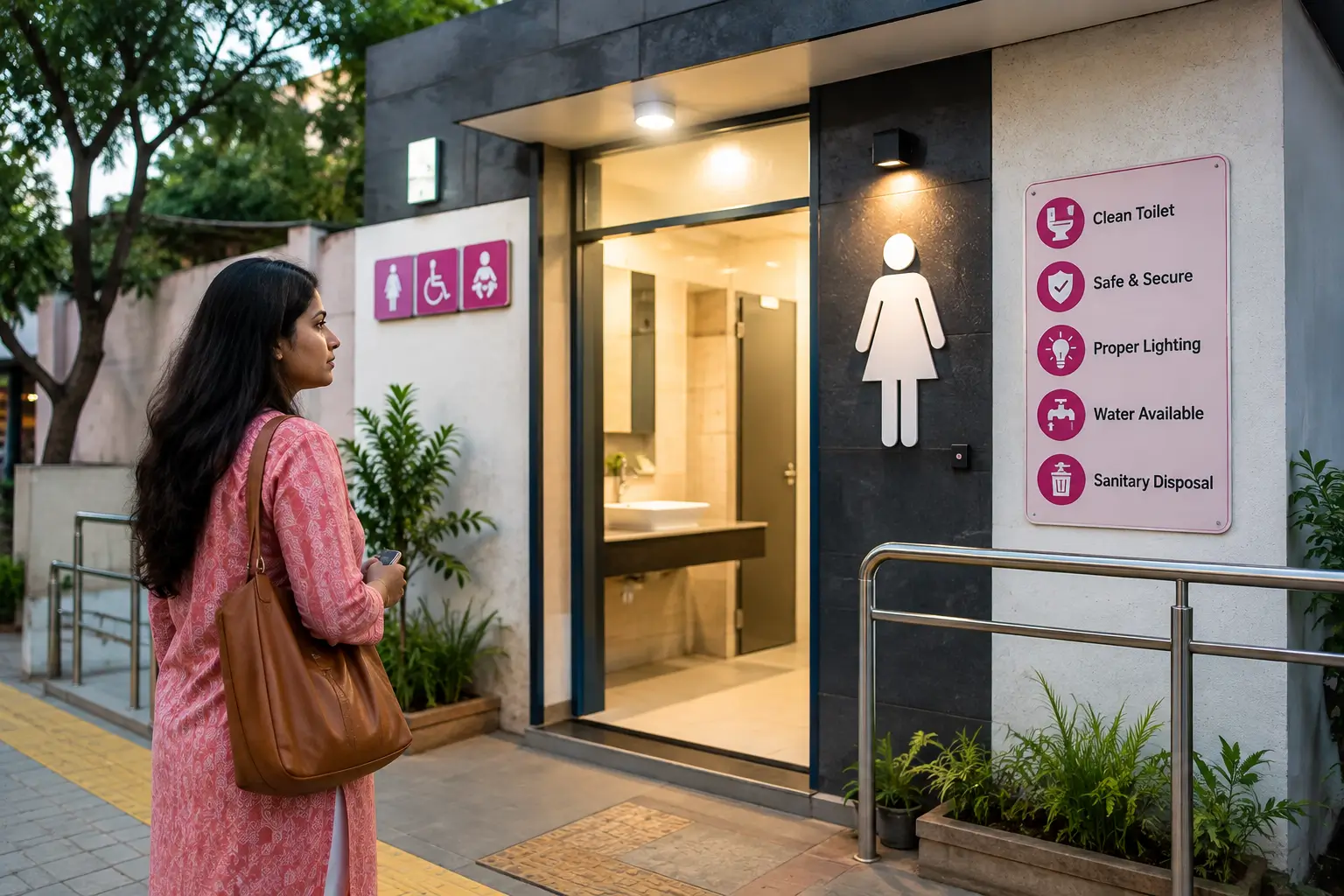
Imagine a woman working in a busy market, travelling across the city, attending college, or taking a long bus journey. She suddenly needs to use a toilet. She finds one nearby, but the entrance looks poorly lit. The door does not lock properly. There is no water or soap. The area around the toilet feels deserted. She decides to wait instead.
This situation may sound simple, but it points to a much bigger problem. Public toilets are not only about sanitation. For women, they also connect with safety, privacy, dignity, health, and the freedom to move around a city without constantly planning where they can find a clean and safe toilet.
India has made major progress in expanding sanitation infrastructure. Under Swachh Bharat Mission-Urban, more than 6 lakh community and public toilet units had been created by 2026, according to government figures. But building toilets represents only one part of the problem. Cities also need to keep them functional, clean, safe, and suitable for women.
Why Public Toilets Matter for Women
A city cannot become truly convenient for women if basic facilities remain difficult to access. Women use public spaces for work, education, shopping, travel, healthcare, family responsibilities, and many other reasons. When a clean and safe toilet is not available, they may have to change their plans or avoid using the facility altogether.
Research on public toilet use in India has found that women can face concerns about cleanliness, safety, and social attitudes when using public toilets alone. This means the problem does not stop at the toilet door. The location, surroundings, and social environment also matter.
Safety Starts Before a Woman Enters the Toilet
A toilet may have a clean interior but still feel unsafe if the route leading to it passes through a dark or isolated area. Women need to feel reasonably safe while walking toward the facility, waiting outside, and leaving after use. Urban sanitation research has highlighted the importance of considering the paths and surroundings around toilets, not just the toilet structure itself.
This is especially important near bus stations, railway stations, markets, parks, and other places that remain busy during the day but become quiet later. Good lighting around entrances and pathways can make a facility easier to locate and can reduce dark spots. Cities also need to think about visibility and natural public activity when deciding where to place a toilet.
Cleanliness Is a Women’s Safety Issue Too
People often discuss toilet cleanliness as a hygiene problem. For women, it can become a much bigger concern. A dirty floor, overflowing waste bin, blocked toilet, or lack of water can make a woman uncomfortable about using the facility. During menstruation, these problems can become even more difficult to manage.
WaterAid India’s guidance on female-friendly public and community toilets points to the need for facilities that address women’s privacy, hygiene, and safety needs instead of treating everyone as if they have identical requirements.
Building fancy public toilets is great, but keeping them clean and working is what really counts. A simple toilet with running water, soap, good lights, a lock, and regular cleaning is far better than an expensive one that breaks down and gets abandoned after a few months.
Women Need Privacy Inside Public Toilets
Privacy may sound like an obvious requirement, but the design of a toilet can either provide it or take it away. Women should have a properly closing door and a functional lock inside each cubicle. The entrance should also provide enough privacy so that people outside cannot easily see inside.
Separate facilities for women and men can provide greater privacy in many public settings. Clear signs also help women quickly identify the correct facility, especially in crowded places such as railway stations, bus terminals, and markets.
Cities should place signs where people can see them before reaching the toilet entrance. Good signs can reduce confusion and make the facility easier to find.
Menstrual Hygiene Needs Proper Attention
A woman may need more than a toilet cubicle during menstruation. She needs water, privacy, a clean place to change sanitary products and a safe way to dispose of used products. A lack of these basic facilities can make travelling, working or spending several hours outside home much harder.
Some Indian cities have already introduced women-focused facilities with features such as sanitary napkin vending machines, disposal systems, changing areas and spaces for mothers with babies.
For example, the government has highlighted women-friendly toilet models such as the Sthree Toilet in Bengaluru, which includes sanitary napkin vending, an incinerator and a baby-feeding and diaper-changing area.
These examples show that city planning can consider the real needs women face instead of stopping at the basic toilet seat.
Public Toilets Should Support Mothers Too
Women travelling with small children often need additional support. A mother may need to change a baby’s diaper, feed the child, or simply have enough space to manage a young child safely.
A small, clean baby-care area can make a public toilet much more useful for families.
Tirupati constructed a dedicated public restroom for women that included changing spaces, sanitary napkin vending machines, and mother-care rooms. The facility, which was designed to withstand large daily visitor numbers, is kept clean by a regular, well-planned maintenance routine.
Cities do not necessarily need to copy one model everywhere. They should understand who uses each location and provide facilities according to local needs.
Better Lighting Can Make a Big Difference
Lighting is one of the simplest improvements cities can make. A dark entrance, poorly lit pathway, or broken light can make women hesitate to use a toilet, especially during early morning or evening hours. Cities should check lights regularly instead of waiting for residents to complain.
Lighting should cover more than the inside of the toilet. Entrances, surrounding pathways, and waiting areas also need attention.
Location Matters as Much as Construction
A public toilet should be easy to reach. If authorities place a toilet behind a building, inside an isolated corner or far away from the main pedestrian route, women may avoid it even when the facility itself is clean. Urban sanitation research has shown why planners need to consider location, access routes and the surrounding environment when designing women-friendly sanitation facilities.
Busy locations can provide a natural level of visibility. Markets, transport hubs, parks and other high-footfall areas often need toilets because large numbers of people spend time there. The government has also encouraged urban local bodies to expand public toilet infrastructure at tourist destinations, high-footfall areas and religious sites.
Accessibility Should Not Be Forgotten
Women are not one single group. Older women, women with disabilities, pregnant women and mothers with children can have very different needs from a healthy young adult. A public toilet should therefore include accessibility features wherever the location and facility require them. Ramps, handrails, suitable cubicles and enough space can make a major difference.
Government examples of inclusive public toilet facilities include ramps, handrails, child-friendly fixtures and accessible sanitation facilities.
Cities Need Better Toilet Maintenance Systems
One of the biggest challenges is keeping public toilets functional after construction. A broken tap may seem like a small problem. A broken lock may seem like another small problem. A missing light may also appear minor.
But when these problems occur together, women may stop using the facility. Cities need regular inspections, cleaning schedules, quick repairs, and a clear system for reporting problems. They should also track whether toilets actually remain operational.
The recent Bengaluru audit provides a useful reminder. It found not only non-functional toilets but also missing basic amenities.
Citizens Should Have an Easy Way to Report Problems
People should not have to visit a municipal office to report a broken toilet. A visible complaint number, QR-based feedback system, or simple digital reporting option can make it easier to report problems.
But the reporting system matters only if someone responds. A complaint that remains unanswered for weeks does not improve sanitation. Authorities need a system that records the complaint, assigns responsibility, and checks whether someone fixed the problem.
Women Should Have a Voice in Toilet Planning
One of the easiest ways to improve public toilets is to ask women what they actually need. Planners can speak with women who work, travel, shop and study in the area. Their experiences can reveal problems that may not appear on an architectural drawing.
For example, women may point out that the toilet has enough cubicles but no safe waiting area. They may explain that the entrance creates privacy concerns or that the route becomes uncomfortable after dark.
These practical observations can help cities make better decisions.
Key Steps for Cities to Fix Public Toilets
- Ensure Access for Everyone: Design facilities for elderly and disabled users, and create an easy way for people to report broken equipment.
- Start with the Basics: Ensure all doors, locks, lights, running water, and toilets actually work.
- Keep Them Clean: Keep high-traffic toilets clean by having staff work throughout the day and emptying trash bins often.
- Make Them Safe: Place toilets in well-lit, visible areas with safe access paths so women feel secure.
- Add Features for Women: Provide sanitary pads, proper trash bins, and mother-and-child rooms.
India Has Made Progress, But Maintenance Must Continue
It is important to recognise the progress India has made in sanitation. The government reports that community and public toilet infrastructure under Swachh Bharat Mission-Urban reached around 6.36 lakh units by 2026. It also reports thousands of cities with ODF, ODF+ and ODF++ certifications.
But the next challenge is clear. Cities need to move from simply providing toilets to providing usable toilets. A toilet that remains locked, lacks water, or has poor lighting does not provide meaningful access. A clean and functional facility, on the other hand, can give women more confidence to travel, work, study, and spend time in public spaces.
Conclusion
Public toilets may look like a small part of city infrastructure, but they have a direct connection with women’s daily lives. A woman should not have to avoid drinking water because she is unsure about finding a toilet. She should not have to choose between using a dirty facility and waiting several more hours. She should not have to worry about a broken lock, a dark entrance, or an unsafe route. Indian cities have already expanded sanitation infrastructure on a large scale. The next step should focus on quality, maintenance, safety, and women’s real needs.
Clean floors, working water, proper locks and good lighting may sound basic. They are basic. But they are also essential. The best public toilets are not necessarily the most expensive ones. They are the ones that remain clean, functional, private, accessible, and safe every day. When cities get these basics right, they do more than improve sanitation. They make public spaces more usable and help women move through the city with greater confidence and dignity.