

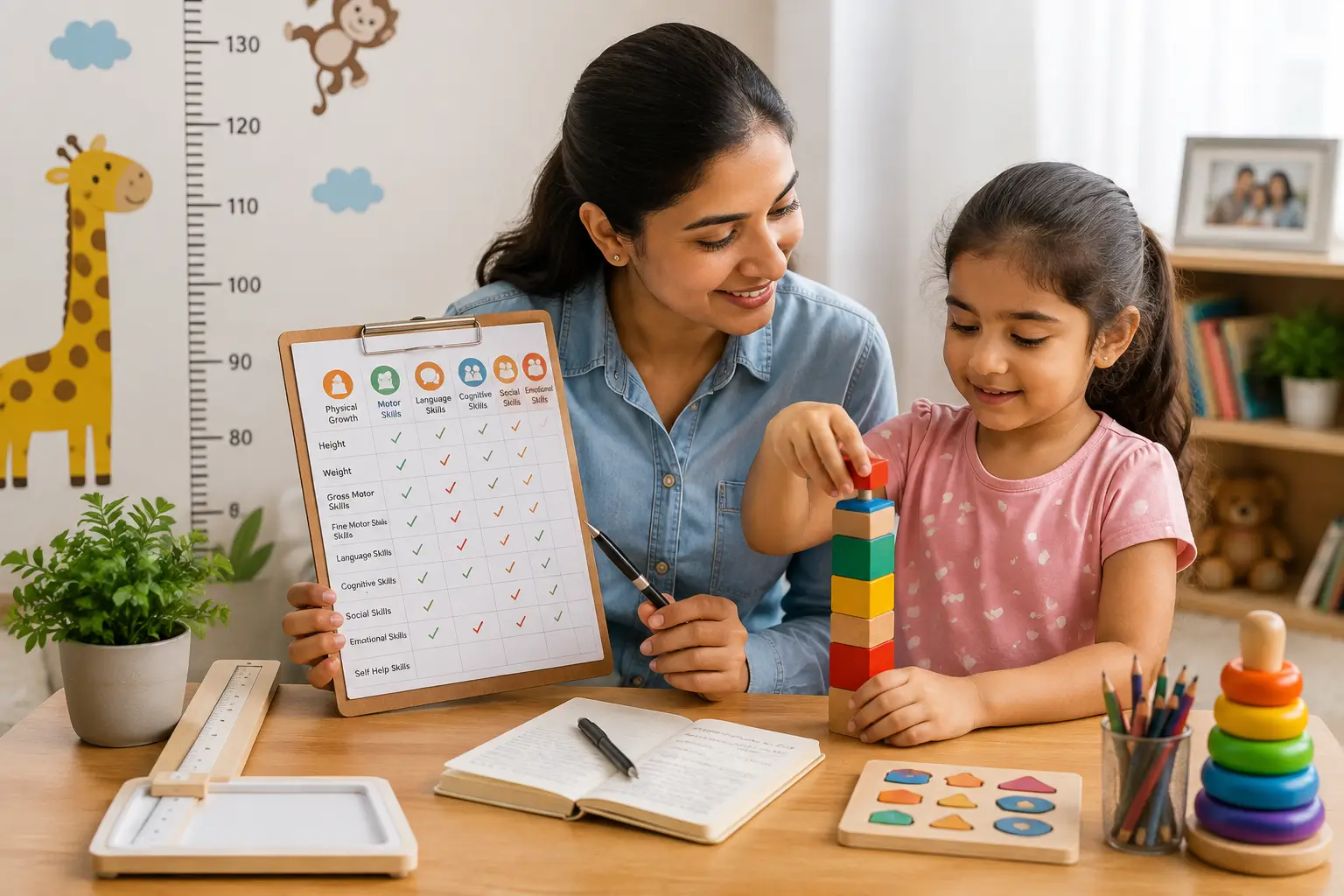
Every parent wants to see their child grow healthy, confident, and independent. We notice when a child becomes taller, gains weight, starts running, or learns to speak. But children grow in many other ways too. They learn to solve problems, communicate, make friends, control emotions, and handle everyday tasks.
This is why parents should look at both physical growth and skill development. Physical growth usually feels easier to track because parents can measure height and weight. Skill development needs more observation because many important changes happen slowly through play, school, family activities, and daily routines.
You do not need complicated methods to track your child’s progress. A simple record and regular observation can help you understand what your child has learned and where they may need more support. The most important point is to track your child’s own progress instead of constantly comparing them with other children.
What Does Physical Growth and Skill Development Mean?
Physical growth refers to changes in the child’s body. Parents and healthcare professionals commonly look at factors such as height, weight, and overall physical development.
Skill development refers to the abilities children gain as they grow. These skills include movement, communication, thinking, social interaction, emotional control, and independence.
For example, a child who learns to climb stairs shows physical and movement development. A child who learns to explain what happened at school shows communication development. A child who learns to wait for their turn during a game develops a social skill.
Why Should Parents Track Child Development?
Parents can learn a lot by watching how their children change over time. Tracking helps you notice progress instead of relying only on memory. Your four-year-old found it difficult to grasp a pencil six months ago. In the present day, they are sketching shapes and adhering to the coloring lines with ease. Although it may seem like a small element, it represents a significant turning point in their educational process.
A development record can also help when you speak with a paediatrician or teacher. Instead of saying that your child “seems different”, you can explain specific things you have noticed. Tracking does not mean testing your child every day. It simply means paying attention.
A) How to Track Physical Growth
1. Monitor Height and Weight
Height and weight provide basic information about physical growth. Parents can record these measurements during routine health visits or whenever a healthcare professional recommends checking them. Do not worry about one measurement alone. Children can grow at different rates during different periods. A doctor looks at the child’s physical growth pattern along with age, sex, family background, and overall health.
If you measure your child’s height or weight at home, try to use reliable equipment and similar conditions each time. Keep the dates with the measurements so you can see the pattern later.
2. Observe Physical Activity
Children naturally use movement to explore the world. Watch how your child walks, runs, jumps, climbs, throws and plays. You may notice that your child becomes more confident with activities that once seemed difficult. A child who needed help climbing stairs may later manage them independently.
Outdoor play can give children many opportunities to practise movement and coordination. You do not need to turn these activities into formal exercises.
B) Track Gross Motor Skills
Children develop thinking skills through play and everyday experiences. Watch how your child solves small problems. Does the child try again after something fails? Can they remember instructions? Do they ask questions? Can they sort objects or complete an age-appropriate puzzle?
You don’t have to put any pressure on kids to learn. Ask children why they believe a toy broke, for instance, if it stops functioning. Let them try to rebuild their block tower if it collapses. These easy exercises foster children’s curiosity and independent problem-solving skills.
C) Track Fine Motor Skills
Fine motor skills involve smaller movements of the hands and fingers. Children use these skills when they hold a pencil, turn pages, use a spoon, build with blocks, button clothes, or handle small objects. Parents can encourage these skills through simple activities. Drawing, colouring, building blocks, puzzles, and age-appropriate crafts can give children useful practice.
These simple observations become useful when you review progress after several months.
D) Track Language and Communication Skills
Language development forms an important part of childhood development. Listen to how your child communicates at home. Notice whether the child understands simple instructions, answers questions, expresses needs, and participates in conversations appropriate for their age.
Do not focus only on the number of words your child knows. Communication also includes listening, understanding, gestures, facial expressions, and the ability to share ideas.
Encourage Communication at Home
Everyday conversations offer excellent practice. Ask your child about their school day. Read stories together and ask what happened in the story. Let the child explain a drawing or describe something they saw outside.
Try not to correct every sentence. Give your child time to speak and respond naturally. If you have ongoing concerns about speech, hearing, or understanding, discuss them with a paediatrician or qualified speech and language professional.
Track Thinking and Learning Skills
Children develop thinking skills through play and everyday experiences. Watch how your child solves small problems. Does the child try again after something fails? Can they remember instructions? Do they ask questions? Can they sort objects or complete an age-appropriate puzzle?
You can encourage these skills without creating pressure. For example, if a toy stops working, ask your child what they think happened. If a block tower falls, let them try building it again. Such activities encourage curiosity and problem-solving.
Use Everyday Activities
You do not need expensive learning materials. Cooking with safe supervision, sorting clothes, arranging toys, reading books, and counting household objects can all create learning opportunities. The goal is not to turn every activity into a lesson. Children learn naturally when parents give them time to explore.
Track Social and Emotional Development
Parents sometimes focus heavily on height, weight, and school marks while forgetting social and emotional development. Children gradually learn how to express feelings, interact with others, share, wait for their turn, and handle disappointment.
Observe your child during family gatherings, playtime, and school-related situations. For example, a child may initially become very upset when another child takes a toy. Later, the child may learn to ask for the toy back or wait for their turn. That change shows developing social and emotional skills.
Children will still have difficult moments. Development does not mean perfect behaviour.
Track Self-Help and Independence Skills
Independence develops through everyday tasks. Depending on age, children gradually learn to eat, dress, wash their hands, organise their belongings, put toys away, and complete simple tasks without constant assistance. Parents often help because it saves time. However, allowing children to handle suitable tasks gives them opportunities to practise.
If your child starts putting their toys away without being reminded, write it down. If they begin dressing themselves with less help, note that too. These small achievements can tell you a lot about growing confidence and independence.
Create a Simple Child Development Tracking Table
A notebook or simple spreadsheet can help you organise your observations.
| Development Area | What You Can Track | Example |
| Physical growth | Height and weight | Record measurements with dates |
| Gross motor skills | Running, jumping, balance | Can jump with better control |
| Fine motor skills | Hand and finger control | Draws simple shapes |
| Communication | Speaking and understanding | Answers simple questions |
| Thinking | Memory and problem-solving | Completes simple puzzles |
| Social skills | Interaction with others | Takes turns during games |
| Emotional skills | Handling feelings | Recovers from disappointment |
| Independence | Daily tasks | Puts toys away independently |
You do not need to update every section every day. Add information when you notice a meaningful change.
How Often Should You Track Your Child?
You can observe your child every day without formally recording everything. For physical growth, follow the schedule recommended by your healthcare professional. For skills, a monthly review can give you a useful picture.
At the end of each month, ask yourself a few simple questions:
- What new thing can my child do now?
- Which activity has become easier?
- What does my child enjoy learning?
- Is there anything that continues to concern me?
These questions can help you notice gradual progress.
Do Not Compare Your Child With Other Children
This may be one of the most important rules for parents. Children develop at different rates. One child may speak confidently early, while another may show stronger physical coordination. One may enjoy drawing, while another may spend hours building things.
Family members may sometimes make comparisons without realising how much pressure they create. Instead of asking, “Why can’t my child do what that child does?”, compare your child’s current abilities with their previous abilities. Progress matters more than competition.
When Should You Talk to a Professional?
Parents should not panic over every difference. At the same time, you should take persistent concerns seriously. Talk to your child’s paediatrician or another appropriate qualified professional if you have concerns about physical growth, movement, speech, hearing, vision, learning, behaviour or social interaction.
Your notes can make this conversation easier. Instead of saying, “My child is slow at speaking,” explain what you have observed. Mention what your child can understand, how they communicate, and what changes you have noticed over time. A qualified professional can decide whether your child needs further assessment or support.
Make Development Tracking Comfortable
Children should not feel that parents are constantly examining or testing them. The best observations often happen naturally. Play with your child, read together, go outside, talk about daily experiences, and give them suitable responsibilities at home.
If your child loves drawing, observe their hand control. If they enjoy outdoor games, watch their coordination and balance. If they enjoy stories, listen to how they understand and explain them.
Conclusion
Tracking physical growth and skill development helps parents understand the complete picture of a child’s progress. Height and weight can tell you about physical growth, while movement, communication, thinking, social behaviour, emotional skills and independence show other important areas of development. You do not need a complicated system. Keep simple records, observe your child during everyday activities, and review their progress from time to time.
Most importantly, avoid turning development into a race. Every child grows at their own pace, and each child can have different strengths. Your job as a parent is not to make your child reach every milestone before everyone else. Your job is to provide a safe, supportive environment, notice meaningful changes, and seek professional advice when something genuinely concerns you. When you track progress with patience rather than pressure, you get a clearer understanding of your child’s physical growth and can support them more confidently at every stage.