

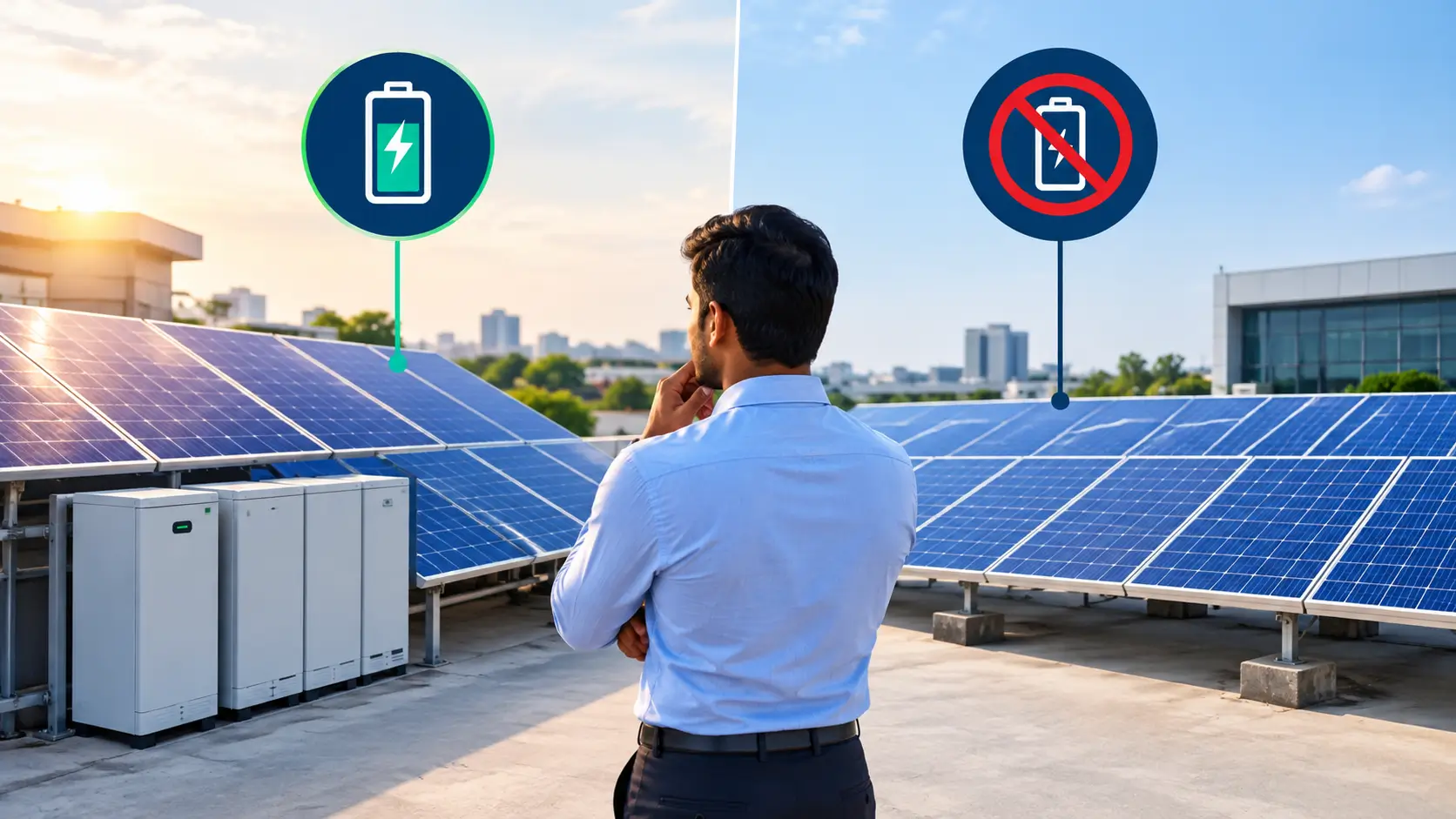
Solar power has become an attractive option for many Indian businesses. Shops, factories, offices, warehouses, schools, hotels, and other commercial buildings can use solar panels to reduce their dependence on grid electricity and manage rising power costs. But installing solar panels is only one part of the decision. A business also needs to decide whether it should add battery storage to the solar system or use solar power without batteries.
This decision can affect the initial investment, electricity savings, and how the business handles power cuts. There is no single answer that works for every business. Your electricity usage, working hours, location, backup needs, and budget all matter.
What Is Commercial Solar?
Commercial solar means using solar panels to generate electricity for a business or commercial property. Businesses can use this electricity for lights, computers, air conditioners, machines, pumps, and other equipment. Depending on the system design and local electricity rules, excess solar power may also be exported to the grid.
A typical commercial solar system can include:
- Solar panels
- Inverters
- Mounting structures
- Electrical protection equipment
- Monitoring equipment
- Batteries, if the business chooses energy storage
The important point is that solar panels and batteries perform different jobs. Solar panels generate electricity. Batteries store electricity for later use.
How Does Commercial Solar Without Battery Storage Work?
A solar system without batteries is simpler. During sunny hours, the solar panels produce electricity. Your business uses this power when it needs it. If your solar panels make more electricity than your building uses, the extra power can often be sent back to the main power grid, as long as local rules allow it. At night, the solar panels stop producing electricity. The business then depends on the grid or another available power source. This setup often works well for businesses that use most of their electricity during the daytime.
How Does Commercial Solar With Battery Storage Work?
A battery storage system stores electricity so the business can use it later. During the day, solar panels can supply the building and charge the batteries when the system has available energy. Later, the stored electricity can support selected loads or other permitted uses depending on the system design.
This can become useful when a business needs electricity after sunset or wants backup power during grid interruptions. For example, a shop may need electricity until 10 PM. Solar panels cannot generate electricity after sunset, but a properly sized battery can provide stored energy for suitable loads. However, batteries increase the total cost and add another component that needs proper installation and maintenance.
Commercial Solar With Battery vs Without Battery
Here is a simple comparison for commercial solar :
| Factor | Solar Without Battery | Solar With Battery |
| Initial cost | Lower | Higher |
| Daytime solar usage | Excellent | Excellent |
| Night-time solar use | Not directly possible | Possible through stored energy |
| Backup during power cuts | Limited depending on system | Can provide backup for selected loads |
| System complexity | Lower | Higher |
| Maintenance | Generally simpler | More involved |
| Space requirement | Lower | Higher |
| Best suited for | Daytime users | Businesses needing storage or backup |
The right choice depends on how your business consumes electricity rather than simply choosing the system with more features.
When Should a Business Choose Solar Without Batteries?
For many commercial solar properties, a battery-free solar system can be the practical starting point.
1. Your business uses most electricity during the day
This is one of the biggest reasons to consider solar without batteries. If your machines, air conditioners, computers, and other equipment operate mainly during daylight hours, you can directly use the electricity generated by your solar panels. This reduces the need to store electricity for later use.
2. You want a lower initial investment
Batteries can add a significant amount to the overall system cost. If your main aim is to reduce electricity bills, adding batteries may not always provide enough additional value to justify the extra investment. A business with a limited solar budget may prefer to install a suitable solar system first and evaluate its performance.
3. Your grid supply is reasonably reliable
If power cuts are uncommon or short in your area, you may not need batteries specifically for backup. In such cases, a battery could remain unused for long periods while still adding cost and maintenance requirements.
4. You have limited space
Commercial properties do not always have unlimited space. Rooftops may already contain water tanks, equipment, or other structures. A battery storage system requires suitable installation space and proper safety considerations. A business should check the available space before making a decision.
When Should a Business Consider Battery Storage?
Battery storage becomes more interesting when the business has a specific reason to store electricity.
1. Your business needs power after sunset
Restaurants, hotels, retail stores, clinics, and some other businesses may continue operating well into the evening. Solar panels alone cannot generate electricity after sunset. Battery storage can help shift some solar energy from the daytime to later hours. The important question is not simply whether you need night-time electricity. You should also check how much electricity you need and for how many hours.
2. Power cuts affect your business
A power interruption can create problems for businesses. A shop may lose sales. A restaurant may face operational issues. A small manufacturing unit may have to stop equipment. An office may lose productivity. Battery storage can provide backup for selected loads when the system has been designed for that purpose. However, businesses should not assume that every solar battery system will automatically power the entire building during a power cut. The system needs the right design, inverter configuration, and electrical setup.
3. You want more control over your energy use
Battery storage can give a business more flexibility in deciding when to use stored electricity. Instead of using solar power only when the panels are generating it, the business can store some energy and use it later. This can be useful when electricity consumption does not match solar generation.
What About Battery Cost and Lifespan?
Battery storage requires careful financial planning. The battery itself is not the only cost. Installation, compatible equipment, electrical work, and future replacement can also affect the total cost of ownership. Battery performance also changes over time. How long a battery remains useful depends on factors such as its technology, usage pattern, operating conditions, and maintenance.
For this reason, businesses should not compare only the purchase price of a battery. Instead, look at the total cost over the expected life of the system. Ask the installer about the battery warranty, expected performance, and replacement terms and conditions that can affect warranty coverage.
What Should Indian Businesses Check Before Choosing?
Before investing in commercial solar, look at your actual electricity usage rather than making the decision based only on the size of your rooftop.
1. Check your electricity consumption pattern
Look at your electricity bills and identify when your business consumes the most power. If most consumption happens between morning and evening, a battery may not provide enough extra value. If substantial consumption continues into the evening, storage deserves a closer look.
2. Check your power-cut situation
Think about how often power cuts happen and how much they affect your business. If a short power cut does not cause much damage, you may not need expensive battery backup. If a power interruption can stop important equipment or affect business operations, battery storage may become more valuable.
3. Compare the complete system cost
Do not compare only the solar panel price. Ask for separate costs for solar panels, inverter, battery, installation, electrical work, maintenance, and other required components. This makes it easier to understand what you are actually paying for.
4. Understand local electricity rules
India has different electricity regulations and procedures across states and distribution areas. Rules related to rooftop solar, grid connection, and exporting excess electricity can vary. Before finalising the system, check the current requirements that apply to your commercial connection with the relevant electricity distribution company or a qualified solar professional.
Should You Buy Battery Storage From Day One?
Some businesses may find it practical to install solar without batteries first and study their actual energy usage. However, the decision should happen during the system planning stage. If you think you may add batteries later, discuss that possibility with the installer before buying the system. The inverter and electrical design should support the future plan where appropriate. A good solar system should match your current needs while leaving sensible options for future changes.
Commercial Solar: Which Option Is Better?
There is no universal winner.
Choose commercial solar without battery storage if:
- Your business uses most electricity during daylight hours.
- You want to keep the initial investment lower.
- Your grid supply is reasonably reliable.
- You do not have a strong need for night-time solar power.
Consider battery storage if:
- Your business needs electricity after sunset.
- Power cuts regularly affect your operations.
- You need backup for important equipment or selected loads.
- Your electricity usage pattern makes energy storage financially useful.
The most important thing is to calculate the value of the battery instead of buying it simply because it makes the solar system look more advanced.
Conclusion
Commercial solar can help Indian businesses reduce their dependence on conventional grid electricity, but adding battery storage is not automatically the best choice. If your business consumes most of its electricity during the day and has a reliable grid connection, solar without batteries may offer a simpler and more cost-effective setup. Battery storage becomes more attractive when you need evening electricity, backup during power cuts, or greater control over when you use stored solar energy.
Before making the final decision, study your electricity bills, operating hours, power-cut history, available space, and total system cost. Get quotes based on your actual consumption rather than choosing a system only by its advertised capacity. The best commercial solar system is not necessarily the biggest one. It is the one that matches how your business actually uses electricity.