

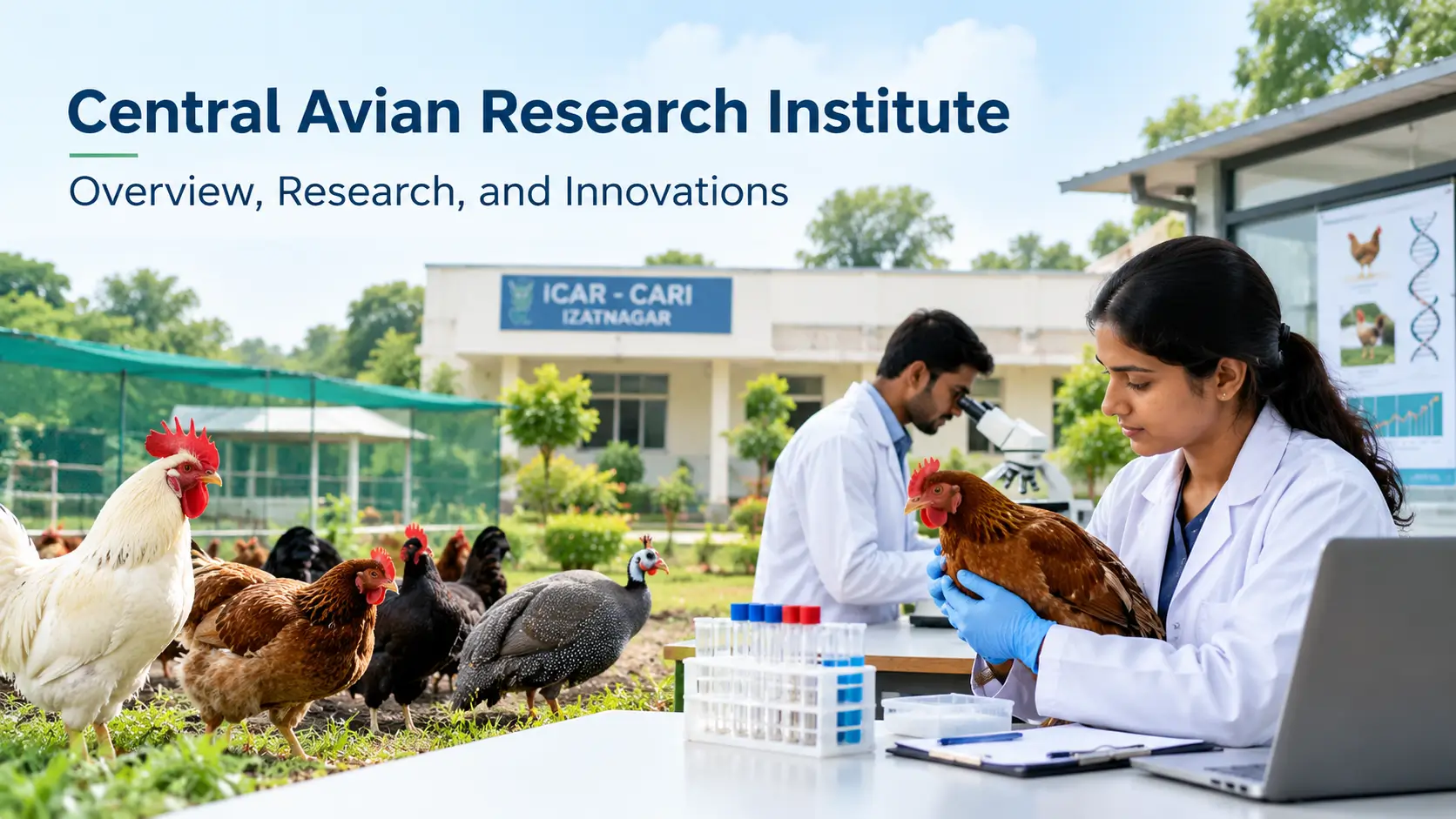
Poultry farming is a big part of agriculture and food in India. Millions of farmers and small businesses rely on birds like chickens, ducks, quails, and turkeys to earn a living. However, successful poultry farming takes more than just birds and feed. Farmers also need stronger breeds, the right nutrition, good disease control, better farming methods, and affordable tools.
This is where the Central Avian Research Institute (CARI) plays an important role. Located at Izatnagar in Bareilly, Uttar Pradesh, CARI works under the Indian Council of Agricultural Research and comes under the Animal Science division. The institute focuses on research and development related to poultry and other avian species. From improving poultry breeds to developing feed technologies and value-added egg and meat products, the institute has worked on several areas that connect scientific research with practical poultry farming.
What Is the Central Avian Research Institute?
The Central Avian Research Institute, commonly known as CARI, is an ICAR institute located at Pilibhit Road, Izatnagar, Bareilly, Uttar Pradesh. ICAR describes its work as basic and applied research for improving productivity and supporting sustainable production in different avian species, including domestic fowl. Its mandate also includes climate-resilient poultry production, better use of farm waste and by-products, food safety, product quality, human resource development, and capacity building.
In simple words, CARI tries to solve practical problems related to poultry production. For example, if a farmer wants better-performing birds, researchers can work on genetic improvement. If feed costs become a major concern, researchers can study alternative feed ingredients. If farmers need better methods for breeding or bird management, research can help develop and test those methods.
When Was Central Avian Research Institute Established?
CARI was established at Izatnagar on November 2, 1979. An ICAR training manual describes the institute as a centre for poultry research, education, extension, and training. The institute was created to support the development of poultry production in India through research and practical knowledge.
Over the years, its work has expanded beyond conventional chicken farming. CARI has worked with different poultry species and has contributed to areas such as breeding, nutrition, reproduction, poultry management, product development, and conservation of poultry genetic resources.
Where Is the Central Avian Research Institute Located?
CARI is located in Izatnagar, Bareilly, Uttar Pradesh, with the postal address listed by ICAR as Pilibhit Road, Izatnagar-243122. Izatnagar is also known for the presence of other important agricultural and veterinary research institutions. This makes the area an important research location for animal and poultry science. The institute is officially listed by ICAR as ICAR-Central Avian Research Institute, Izatnagar, under the Animal Science division.
What Does the Central Avian Research Institute Do?
CARI’s work covers several areas of poultry science. The main purpose is to improve productivity while also making poultry production more practical and sustainable.
Poultry Breeding and Genetic Improvement
Better birds can make a major difference to a farmer’s income. CARI has worked on improved germplasm and genetic resources for different poultry species. According to ICAR, the institute has developed and propagated improved germplasm of Japanese quails, turkey, Guinea fowl, ducks, and indigenous fowls, along with broiler and layer chickens.
CARI has also worked on the conservation and improvement of indigenous poultry. One example is CARI-NIRBHEEK, which was developed for backyard poultry production and tested under different agro-climatic conditions. ICAR reports that the birds went through field evaluation before their release for commercial use under backyard and scavenging systems. Such research can matter because backyard poultry often needs birds that can perform under local conditions rather than depending only on intensive commercial systems.
Poultry Nutrition and Feed Research
Feed is one of the major costs in poultry farming. A farmer cannot expect good growth or egg production if birds do not receive the right nutrients. CARI has studied different feed ingredients and feed-related technologies. The ICAR institute profile says that the institute evaluated more than 36 non-conventional feedstuffs for poultry use. It has also worked on feed additives, mineral premixes, toxin binders, herbal antimicrobials, prebiotics, and probiotics.
The institute has also developed feeding standards for different categories of poultry birds. CARI has promoted MakeFeed Poultry, a least-cost feed formulation software designed to help with poultry feed formulation. ICAR describes it as a user-friendly system with operational manuals. The basic idea is simple: farmers and poultry professionals need to understand what nutrients birds require and how to prepare feed in a cost-effective way.
Research on Poultry Reproduction
Reproduction is another important part of poultry production. CARI has research work in avian physiology and reproduction. One area involves poultry semen and artificial insemination. ICAR has reported the development of poultry semen diluent technologies that help preserve semen and support artificial insemination. Such research can help researchers and poultry breeders use desirable genetic traits more effectively.
CARI also works on reproductive technologies and related research involving different avian species. The importance of this work becomes clearer when we consider poultry breeding. A farmer or breeding programme needs reliable reproductive methods if it wants to maintain and improve desirable traits over generations.
Research on Poultry Housing and Management
Birds need suitable housing and proper management to remain healthy and productive. Central Avian Research Institute scientists also work in areas related to poultry housing and management. Recent scientific research involving CARI scientists has covered cage-free egg production and poultry housing practices.
This type of research looks at how birds are housed and managed rather than focusing only on breeding or feed. For farmers, better housing can help create a more suitable environment for birds while supporting practical farm management.
Food Products and Value Addition
CARI’s work does not stop with producing eggs and meat. The institute has also developed technologies for value-added poultry products. ICAR lists several egg products such as egg rings, stuffed eggs, enrobed egg products, egg strips, and egg waffles. It also lists meat products including chicken cutlets, chicken gizzard snacks, spent hen meat blocks, and other processed products.
The institute profile reports that CARI has developed and commercialized 48 novel poultry processed products. This area can create additional opportunities because processing can give poultry products a different market beyond selling fresh eggs or live birds.
Recent Research and Innovation at CARI
Central Avian Research Institute continues to work on modern poultry research. One recent example involves the genome of India’s Red Junglefowl. ICAR reported that CARI researchers, working with the International Livestock Research Institute, generated a chromosome-scale genome assembly of India’s Red Junglefowl. The research can support the study and conservation of genetic diversity in this important ancestral poultry species.
The institute also hosted an international workshop in 2025 on primordial germ cell biobanking and surrogate technology for conserving chicken genetic resources. Scientists received practical training in methods related to the conservation of poultry genetic diversity.
These examples show how poultry research now extends beyond traditional breeding and feeding. Modern research can also involve genetics, conservation, reproductive biotechnology, and advanced laboratory methods.
CARI’s Work for Farmers and Rural Communities
Research becomes more useful when farmers can apply it in real life. CARI has worked on technologies for backyard poultry and alternative poultry species. For example, ICAR reported a CARI technology for improving Guinea fowl production during the winter season. The research aimed to reduce the seasonal limitation on egg production and improve reproduction.
Such work can be particularly useful for small farmers because backyard and small-scale poultry systems often operate with different resources from large commercial farms. CARI also has a role in training and capacity building. ICAR reported in 2026 that two CARI scientists received the World’s Poultry Science Association Education Award for their contributions to poultry education, capacity building, innovation, training, and outreach.
Why Is the Central Avian Research Institute Important?
Central Avian Research Institute matters because poultry farming involves many connected areas. A farmer needs good birds. Those birds need suitable feed. They need proper housing and management. Breeding requires reliable reproductive methods. Farmers also need practical technologies that can improve income and reduce production problems.
Central Avian Research Institute brings research into many of these areas. Its work on indigenous poultry is also important because India’s poultry resources include local breeds and varieties that need conservation and proper use. Modern genetic research can help researchers understand and protect this diversity.
Quick Overview of Central Avian Research Institute
| Particular | Details |
| Full Name | Central Avian Research Institute |
| Abbreviation | CARI |
| Parent Organisation | Indian Council of Agricultural Research |
| Location | Izatnagar, Bareilly, Uttar Pradesh |
| ICAR Division | Animal Science |
| Established | 1979 |
| Main Focus | Poultry and avian research |
| Major Areas | Breeding, nutrition, reproduction, management, products, and genetic resources |
Conclusion
The Central Avian Research Institute is an important Indian research institute working in poultry and avian science. Since its establishment in 1979, it has contributed to breeding, nutrition, reproduction, poultry management, value-added products, genetic resource conservation, and farmer-oriented technologies.
Its work also shows how poultry research has changed over time. Today, research can involve everything from affordable feed and backyard poultry to genomics and advanced conservation technologies. For Indian farmers, students, poultry professionals, and people interested in agricultural research, Central Avian Research Institute provides an important example of how scientific research can address practical problems in the poultry sector.