

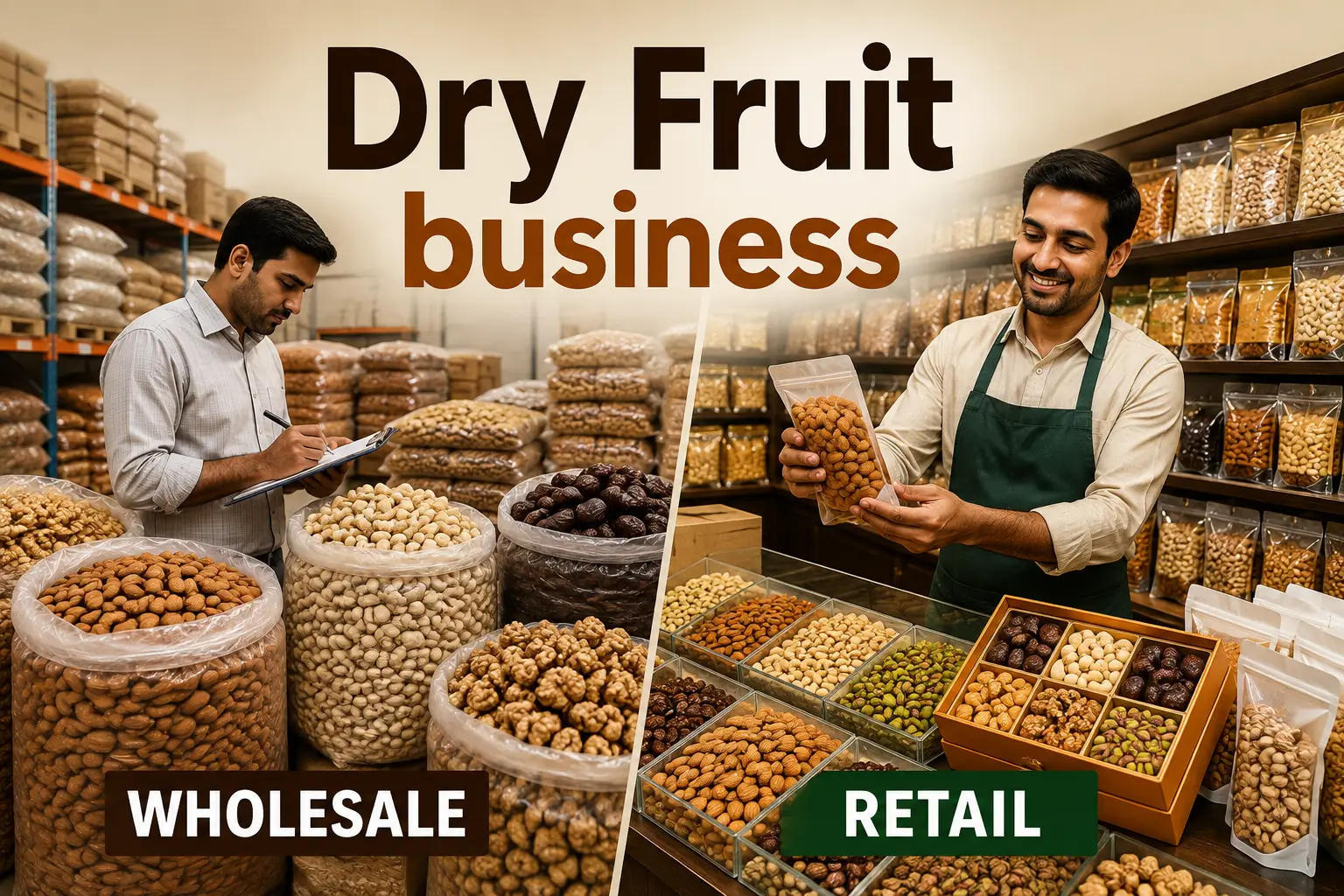
The Dry Fruit Business has become an interesting option for people looking to start a food-related business in India. People buy dry fruits like almonds, cashews, raisins, pistachios, walnuts, dates, and figs all year round. Demand usually increases during festivals, weddings, and special occasions. Many families also buy dry fruits for daily snacks, gifting, and healthy eating.
A wholesale dry fruit business usually depends on large-volume sales and lower margins per kilogram. A retail business generally allows higher margins on individual products, but it needs more effort in branding, packaging, customer service, rent, and marketing.
For example, a wholesaler may sell 100 kg of almonds to several retailers and earn a smaller margin on each kilogram. A retailer may sell the same almonds in 250-gram or 500-gram packs at a higher margin, but the retailer must spend more time finding and serving individual customers.
So, the model with the highest margin percentage does not always produce the highest profit.
Wholesale vs Retail Dry Fruit Business: Quick Comparison
| Factor | Wholesale Dry Fruit Business | Retail Dry Fruit Business |
| Main customers | Retailers, shops, distributors, businesses | Individual consumers |
| Sales volume | High | Low to medium per customer |
| Margin per unit | Usually lower | Usually higher |
| Investment | Can be high because of inventory | Depends on store and stock size |
| Shop requirement | Warehouse or commercial space | Shop, counter or online setup |
| Customer base | Fewer but larger buyers | More customers |
| Marketing need | Moderate | Higher |
| Packaging | Basic or bulk packaging | Attractive consumer packaging |
| Credit risk | Can be higher with business buyers | Usually lower with direct payment |
| Best suited for | People comfortable with bulk sales | People comfortable with customer-facing sales |
The actual margin depends on product quality, buying price, location, quantity, competition, packaging, wastage, and sales channel.
Advantages of a Wholesale Dry Fruit Business
- Large Order Sizes: Wholesale customers usually purchase more products in one transaction. One retailer may purchase several kilograms of almonds, cashews, and raisins at once. This can help you move inventory faster.
- Lower Customer Acquisition Effort: You may need fewer customers to generate significant sales. For example, 20 regular retailers can sometimes generate more monthly volume than hundreds of individual customers.
- Faster Stock Movement: A successful wholesale operation can move inventory quickly. This matters because dry fruits have a shelf life. Faster stock movement can reduce the risk of keeping products for too long.
- Scope for Business Expansion: Once you develop relationships with retailers in a particular area, you can gradually approach more shops, supermarkets, restaurants, and other buyers. You can also expand your product range after understanding what your customers regularly purchase.
Disadvantages of Wholesale Dry Fruit Business
Wholesale may look attractive because of large orders, but it comes with its own challenges.
- Higher Working Capital: You need enough money to maintain stock. If you receive a large order but don’t have enough inventory or cash to replenish the stock, you may lose the opportunity.
- Lower Margin Per Unit: Wholesale customers expect competitive prices because they also need room to make their own profit. This limits the amount you can charge compared with a retail customer.
- Credit Sales: Some business customers may request credit. Credit can help you build relationships, but delayed payments can create cash-flow problems. A business can show good sales on paper while still struggling to pay suppliers because customers have not paid their bills.
- Price Fluctuations: Dry fruit prices can change based on supply, season, import costs, currency movements, and market conditions. A wholesaler who keeps a large inventory needs to manage these changes carefully.
Advantages of a Retail Dry Fruit Business
- Higher Potential Margin Per Product: Retailers generally have more pricing flexibility than wholesalers. You can sell small packs and premium products based on quality, packaging, and customer demand. However, competition can limit your pricing power.
- Direct Customer Relationship: You interact directly with the final customer. This gives you an opportunity to understand what people want. For example, you may discover that customers in your area prefer roasted almonds, premium cashews, seed mixes, or gift boxes. After looking at the results, you can change and update the items you sell to better fit what works.
- Branding Opportunities: Retail gives you more opportunities to build a brand. You can create your own packaging, labels, and gift boxes. A customer may remember your brand and return for another purchase.
- Online Sales: A retail dry fruit business can also sell through its own website, social media, marketplaces, or local delivery channels. This can help you reach customers beyond your physical shop.
Disadvantages of Retail Dry Fruit Business
Retail offers better pricing opportunities, but it requires more day-to-day effort.
- Higher Operating Costs: A physical shop can involve rent, electricity, staff, and maintenance costs. A premium location may bring more customers but also increase your monthly expenses.
- More Competition: Customers can compare prices easily. Local dry fruit shops, supermarkets, online sellers and established brands may compete for the same customer.
- Packaging Matters: Retail customers often judge food products by cleanliness, packaging, and presentation. Poor packaging can make even a good-quality product look less attractive.
- Customer Service: Retail requires regular interaction with customers. You need to answer questions about quality, price, varieties, storage, and packaging.
How to Increase Profit in a Dry Fruit Business
- Buy Carefully: Your buying price has a major effect on your margin. Compare suppliers instead of choosing the first supplier you find. At the same time, don’t sacrifice quality simply to save a few rupees per kilogram. Poor-quality stock can lead to customer complaints and repeat business problems.
- Reduce Wastage: Dry fruits can lose quality if you store them poorly. Use clean and suitable storage conditions and follow proper stock rotation. Keep older stock moving before newer stock whenever appropriate.
- Create Different Price Ranges: Don’t sell only one quality level. You can offer regular, premium, and gifting options based on your customer base. This gives customers more choices without forcing everyone into the same price range.
- Focus on Festivals: Demand can increase during festivals, weddings, and gifting seasons. You can prepare gift boxes and combination packs before these periods. But don’t purchase excessive stock simply because you expect high festive demand. Plan according to previous sales and realistic local demand.
Mistakes to Avoid Before Starting Dry Fruit Business
1. Buying Too Much Stock
New business owners sometimes purchase large quantities because bulk buying offers a better price. But unsold stock can block your money. Start with products that have proven demand and increase inventory gradually.
2. Focusing Only on Margin
A product may offer a high margin but sell very slowly. A product with a smaller margin may generate more total profit if customers buy it regularly.
3. Ignoring Quality
Dry fruits are food products. Quality directly affects customer trust. Always source products carefully and maintain clean storage and handling practices.
4. Giving Too Much Credit
Wholesale customers may ask for credit. Set clear payment terms and keep proper records. A large outstanding amount can create serious cash-flow pressure.
5. Ignoring Packaging
Retail customers care about presentation. Use clean, practical and properly labelled packaging that protects the product.
Conclusion
The Dry Fruit Business offers opportunities in both wholesale and retail markets, but the two models work in very different ways. If you have good supplier connections, enough working capital, and relationships with retailers, wholesale can become a strong business model. If you have a good location, enjoy dealing with customers, and want to build your own brand, retail may offer more opportunities.
You can also start small and gradually move toward a hybrid wholesale and retail model. The most important lesson is not to chase the highest margin percentage. Instead, look at your total sales, actual expenses, stock movement, and final net profit. You can protect your business by focusing on a few products, testing local demand, and keeping your inventory under control.