

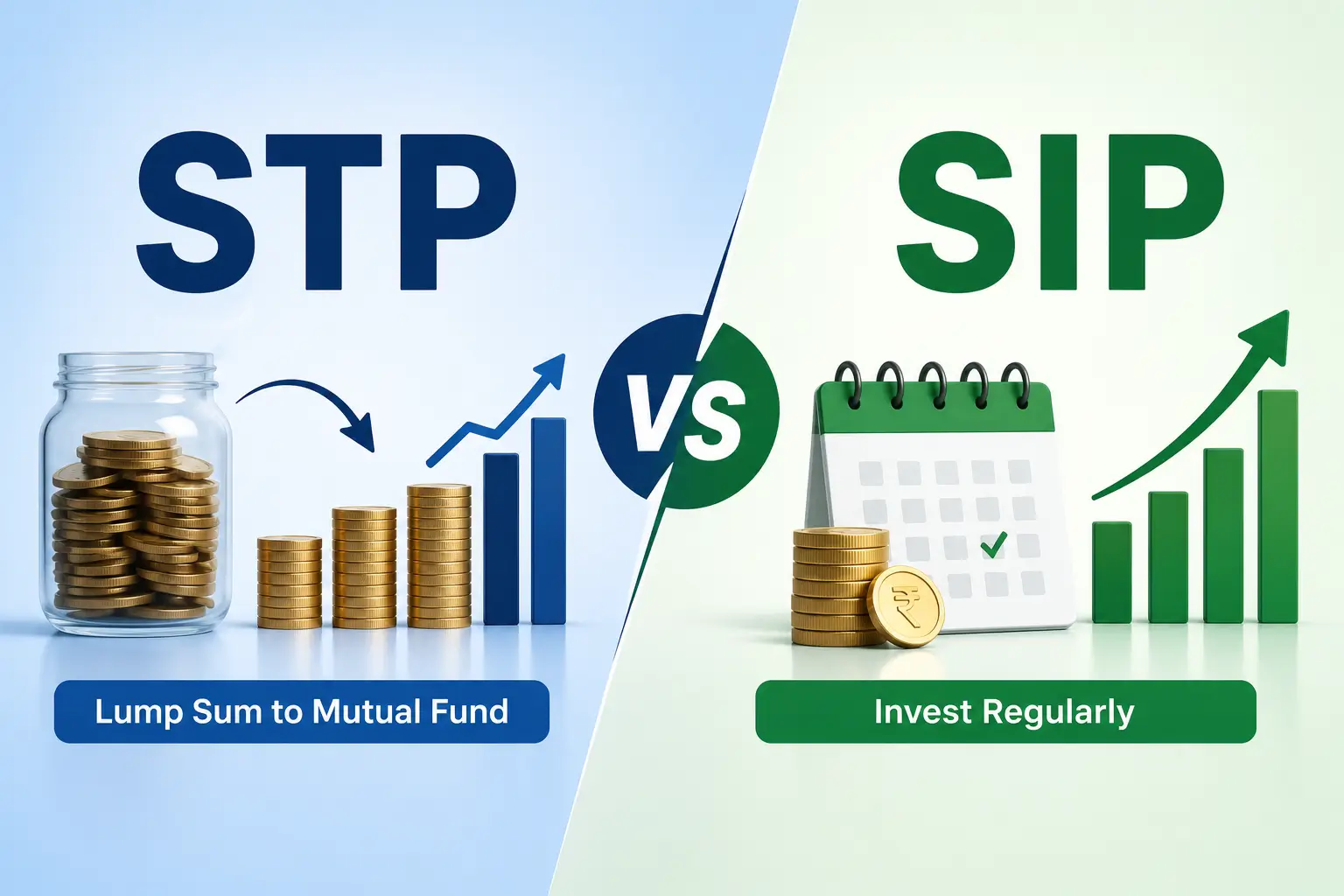
A common question people ask when investing in mutual funds is:
Should I invest through SIP or use an STP?
The answer depends on how you receive your money.
- If you earn a regular monthly salary, a Systematic Investment Plan (SIP) is usually the better choice.
- If you already have a large lump sum to invest, a Systematic Transfer Plan (STP) can help reduce market timing risk by investing gradually.
Although both strategies involve investing in mutual funds over time, they serve different purposes. Understanding how they work will help you make smarter investment decisions.
STP vs SIP at a Glance
| Feature | SIP | STP |
| Full Form | Systematic Investment Plan | Systematic Transfer Plan |
| Best For | Monthly income | Lump sum investment |
| Investment Source | Bank account | Existing mutual fund |
| Initial Lump Sum Required | No | Yes |
| Investment Style | Regular investments | Gradual transfer from one fund to another |
| Market Timing Risk | Lower | Lower than lump sum investing |
| Suitable For | Salaried individuals | Investors with bonuses, inheritance or sale proceeds |
What Is SIP?
It’s a simple way to invest a set amount of money in a mutual fund on a regular schedule.
Instead of investing ₹1 lakh at once, you may invest:
- ₹5,000 every month
- ₹10,000 every month
- ₹20,000 quarterly
This helps you build wealth over time by keeping you consistent with your investments.
What Is STP?
A Systematic Transfer Plan (STP) is used when you already have a lump sum amount to invest.
Instead of investing the entire amount into equity on a single day, the money is first invested in a relatively low-risk fund (usually a liquid or debt fund). A fixed amount is then transferred periodically into an equity mutual fund.
Key Differences Between SIP and STP Mutual Fund
| Parameter | SIP | STP |
| Investment Source | Fresh money from bank | Existing mutual fund investment |
| Suitable For | Salaried investors | Lump sum investors |
| Initial Investment | Small amount | Large amount |
| Frequency | Monthly, weekly or quarterly | Weekly, monthly or quarterly |
| Goal | Long-term wealth creation | Gradual deployment of lump sum |
| Risk | Moderate | Lower than investing the full lump sum at once |
Benefits of SIP Mutual Fund
SIP remains one of the easiest ways to start investing.
Major advantages include:
- Disciplined investing
- Small monthly investments
- Rupee cost averaging
- Long-term wealth creation
- Power of compounding
- Easy to start
- Suitable for beginners
- Flexible investment amounts
Benefits of STP Mutual Fund
STP offers several advantages when you already have a large amount available.
Key benefits include:
- Reduces market timing risk
- Better utilisation of the idle lump sum money
- Gradual exposure to equity
- Lower emotional investing
- Can help smooth entry into volatile markets
- Flexible transfer frequency
When Should You Choose a SIP Mutual Fund?
SIP is ideal if:
- You receive a monthly salary.
- You want to build wealth over many years.
- You don’t have a large lump sum.
- You prefer automatic investing.
- You are a beginner.
When Should You Choose an STP Mutual Fund?
STP is suitable if you have received:
- Annual bonus
- Inheritance
- Sale proceeds from the property
- Maturity amount from investments
- Retirement benefits
- Business profits
Instead of investing everything in equity immediately, STP allows phased investing.
STP vs Lump Sum Investing
| Situation | Better Choice |
| Stable market with long investment horizon | Lump Sum may be suitable |
| Highly volatile market | STP |
| Large one-time investment | STP |
| Monthly salary | SIP |
Taxation: SIP vs STP
Many investors overlook taxation while choosing between SIP and STP.
- SIP: Tax applies only when mutual fund units are redeemed, based on the applicable capital gains rules for the type of fund.
- STP: Every time you move money from one fund to another, it is considered a sale. This can trigger taxes on your profits, depending on the type of fund and how long you held it. It is important to keep this in mind before setting up an STP.
Common Mistakes Investors Make
To help your investments grow, try to avoid these common pitfalls:
- Investing a huge lump sum blindly: Don’t just dump all your money in at once without looking at how the market is doing.
- Overlooking taxes: Make sure you understand the tax rules before starting an STP.
- Stopping your SIPs when the market drops: Panic-selling or stopping your regular investments during a market dip often hurts your long-term progress.
- Trying to “time” the market: It is not possible to guess the perfect time to buy or sell, so it is better to just keep your money invested.
- Losing sight of your goals: Keep your long-term plans in mind and remember why you started investing in the first place.
- Chasing past performance: Don’t pick a fund just because it had high returns recently; those gains don’t guarantee future success.
Which Strategy Offers Better Returns?
Neither SIP nor STP guarantees higher returns.
Returns depend on:
- Fund selection
- Asset allocation
- Market performance
- Investment horizon
- Investor discipline
SIP and STP are investment methods—not different mutual fund products.
Which Strategy Is Best for You?
| Investor Type | Recommended Strategy |
| Salaried employee | SIP |
| Freelancer with irregular income | SIP or STP depending on cash flow |
| Business owner with surplus funds | STP |
| Property seller | STP |
| Retired investor | STP (depending on goals) |
| First-time investor | SIP |
Best Practices for Smart Investing in a Mutual Fund
Follow these simple rules to help your money grow effectively:
- Start early: If you start the investment early, you get more time for your money to grow.
- Stay consistent: Don’t stop investing just because the market is down.
- Check your progress: Review your investments once a year to make sure you are still on track.
- Pick funds that fit your goals: Choose investments based on what you want to achieve, not just what is popular.
- Ignore short-term trends: Don’t pick an investment just because it did well for a short time.
- Keep an emergency fund: Make sure you have some cash set aside for emergencies before you start investing in the stock market.
Final Thoughts
Choosing between SIP and STP comes down to your personal goals and how you have your money. Whether you invest slowly over time or move a larger sum gradually, the key to success is picking the strategy that fits your needs and staying consistent for the long run.
Frequently Asked Questions
1. Is STP better than SIP?
Not necessarily. STP is better when you already have a lump sum amount to invest, while SIP is ideal for investing regularly from monthly income.
2. Can I convert my lump sum investment into an STP?
Yes. Many mutual fund houses allow you to invest in a liquid or debt fund first and then systematically transfer money into another scheme within the same AMC.
3. Which is less risky?
Both strategies reduce timing risk compared with investing a large amount in equity at once, but they are still subject to market risk because the destination investments may be equity mutual funds.
4. Is STP available across different fund houses?
No. STPs generally operate only between eligible schemes offered by the same mutual fund company (AMC).
5. Can I use both SIP and STP together?
Yes. Many investors use STP for deploying a lump sum while continuing their regular SIPs for ongoing investments.